SBA News

Lessons for Black-owned Businesses

Another Small Business Week has ended with many on an emotional and intellectual high following the riveting speeches and networking opportunities shared during the week. Event after event addressed the theme of the week, with a specific focus on each age demographic involved. From the leaders in business support organisations and financial institutions, to students immerse in learning about entrepreneurship for their career planning, to policymakers task with facilitating an enabling regulatory environment, and the business owners themselves, all stakeholders were challenged to consider a Transformative Agenda that is Fit for Purpose”.  

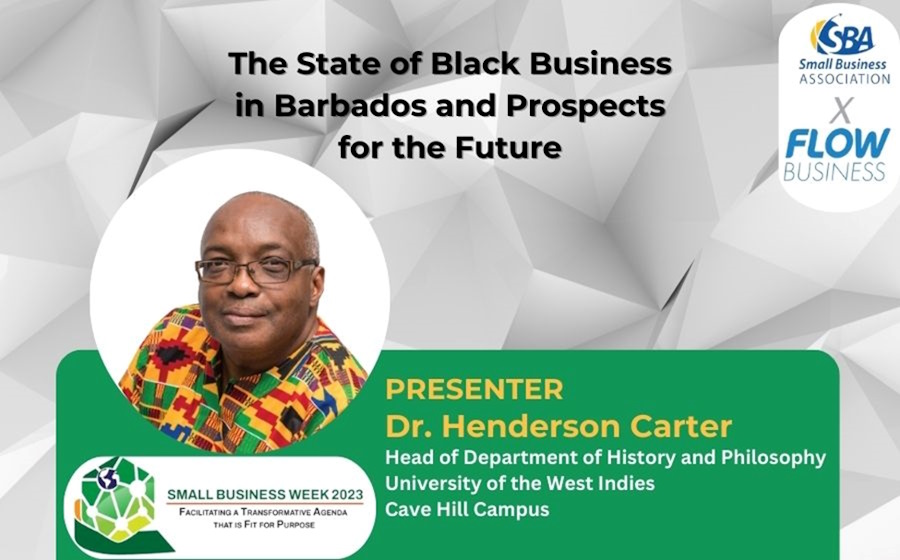
The kernels of truth shared by Dr Henderson Carter on the state of Black businesses underscored the main issue affecting many small firms in Barbados and the reasons for the lack of generational growth across Black-owned firms. Too many of the success stories from the 50s, 60s and 70s, no longer exist primarily due to a lack of succession planning and resilience building at the firm level.

Citing his extensive research on the history of black businesses in Barbados, Dr Carter proffered that the early black entrepreneurs made it in the most difficult circumstances, but succession issues contributed to the eventual failure of many of these firms.  In 1960, there were 1,865 grocery/rum shops on the island, but that number fell dramatically by the 1990s. 

Dr Carter cited the resilience of the early Black entrepreneurs as a key reason for their success back then. However, as the business environment changed, many of these firms did not adapt to address areas like business continuity, to give successive owners a platform on which to continue the enterprise. This resulted in many of these businesses eventually closing.

He observed that the cloud of white domination that exists can be countered by cooperation and unity within the black business sector.  He cited the example of the Indo-Barbadian community that cleaves together and unites to grow their businesses. One example of this is their influence on the transportation sector.

The lack of consciousness among Black businesses was highlighted as a major reason for succession failure. Unfortunately, many family members shy away from carrying on the business opting rather to enter the civil service as their career path. Barbadians had little time for an understanding of their history, not appreciating that this knowledge helped entrepreneurs to understand the society in which they lived.  

Since the focus during Small Business Week was on transformation, several simple solutions were offered by Dr Carter, that if applied, can help this generation of firms to position for sustainability.

First, entrepreneurs must invest in knowledge and research. They must listen to what workers and customers are saying about their businesses, understand how their type of business is conducted in other countries and what technology is being used.  They need to know why other businesses have failed so that they can avoid the mistakes made.

Second, businesses must seek partnership with other trusted businesspersons. Our businesses tend to be one product, but growth can occur with wider partnerships with another firms. Examples of this are Goddards Enterprises Limited and Williams Industries, as well as small businesses including Seaview and The Garage in Bathsheba. 

Other examples cited were taxi operators who can partner with tour guides, and agricultural enterprises who can partner with restaurants. Businesses owners must improve their networking activities, which will provide opportunities for further expansion.

A third solution is to consider the kind of person being employed in the firm. Businesses must employ people with positive attitudes, skills and ideas, who are not just interested in earning a wage but can evolve to be future shareholders of the business.

Another best practice was the recording of business activity to keep accurate data of the firm’s journey. Notes of annual meetings should be preserved, and the production of memorabilia developed throughout the life of the business, to further add value.

The final solution was the importance of memorialising the black trailblazers to demonstrate the accomplishments of those pioneers, and how they were able to transition from one endeavor to another. Plaques containing brief reviews of those trailblazers should be erected across Barbados to highlight their accomplishments and educate the population, young and old, about our history.

Examples shared included Charles Miller Austin, a blacksmith who became a successful planter and businessman, Andrew Bynoe who worked at Cave Shepherd and R L Seale before opening Carlton and A-1 Supermarket, and Everson Elcock who worked at Mannings and Company before starting his electronic contracting company. Young people must be educated to understand that they can aim for entrepreneurship even if they start by working in a job of a similar field.

Ensuring that Black businesses build succession in their firms will provide a further opportunity for young people to secure jobs through apprenticeships and job attachments. Dr Carter contended that the youth do not have to leave Barbados to find employment since opportunities abound right here through improving the ecosystem that supports entrepreneurship; stakeholders simply need to prepare for this rewarding experience.
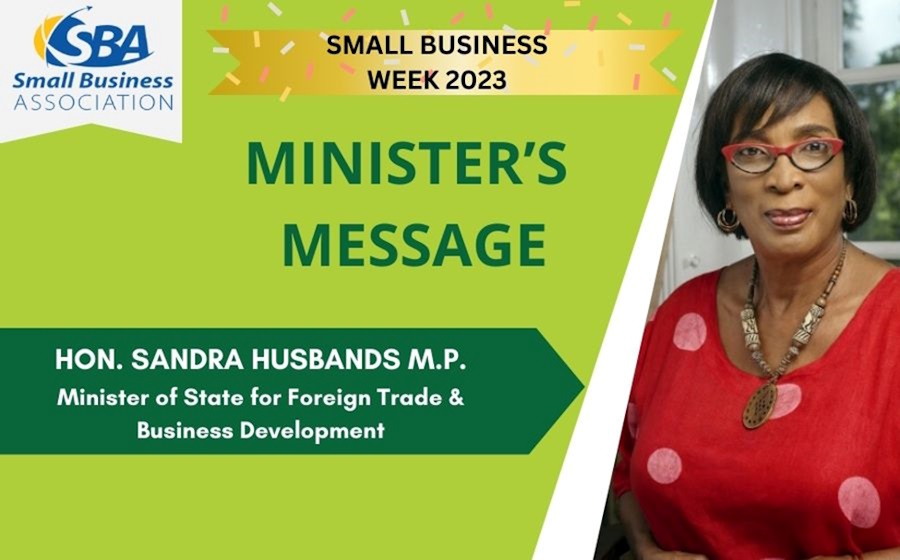

Message from the Hon. Sandra Husbands, Minister of State for Foreign Trade & Business Development, to Commemorate the start of Small Business Week 2023

The theme for Small Business Week of “Facilitating A Transformative Agenda that is Fit for Purpose” has provoked our sensitivities by focusing our eyes on the gaps between the exploration of opportunities, development of transformative strategies and taking decisive action to ensure that those policies and initiatives are implemented to generate economic value in a way that links commercial success to societal advancement.

While we contemplate this challenge, we must also reflect on the current state of affairs. The World Economic Outlook Update for July 2023 indicates that “the global recovery from the COVID-19 pandemic and Russia’s invasion of Ukraine is slowing amid widening divergences among economic sectors and regions”. It further states that supply chains have largely recovered, and shipping costs and suppliers’ delivery times are back to pre-pandemic levels. But forces that hindered growth in 2022 persist. Inflation remains high and continues to erode household purchasing power.

The Central Bank of Barbados’ report on Barbados’ Economic Performance for the first 6 months of the year has echoed the World Economic Outlook’s sentiments of global resilience, by underscoring Barbados’ own resilience in the face of unfavourable global developments. The report highlighted that “economic activity expanded by 3.9 percent, representing the ninth consecutive quarter of economic expansion. This growth resulted in fiscal surpluses, improved employment, reduced debt-to-GDP ratio, a narrowing gap between the value of exports and imports and record foreign reserve levels. The increased economic activity also fed into the financial services sector, improving credit quality, as well as boosting assets and profits”.

Needless to say, the most recent report on the performance of Barbados’ economy is testament to the strident efforts of the business sector, (including micro, small and medium enterprises (MSMEs)) with the support of entities such as the Small Business Association to reimagine and rethink the way businesses operate in the face of the vulnerabilities laid bare by daunting geopolitical circumstances. Certainly, this augurs well for the systematic steps being taken by the various echelons of society to maintain enhanced productivity and enable growth.

My government has made known its commitment to enabling the long-term recovery and stability of the Barbados economy. The promotion of economic diversification, enhancement of competitiveness, boosting of growth and development of systems that reduce unnecessary bottlenecks and bureaucracy has been core to our strategy.

Intent on not being left behind by the global changes in technology, which continue to transform the digital trading landscape and has seen the rise of Industry 4.0, both of which threaten to accelerate progress for advanced economies and deepen existing inequities between those economies and lesser developed economies, my government stands alert. The pursuit of programmes to address those inequities and narrow the digital divide whilst bolstering the capacity, competitiveness and export performance of MSMEs remains paramount.

To attain progress, we must stand together. Establishing an enabling environment requires multifaceted strategic implementation and participation at all levels of governance in order to foster innovation and present opportunities for business.

In my estimation, to effect positive change and derive the benefits of any initiative, we must start by changing our mindsets and take a holistic approach to the success we wish to achieve. Within the last several years the government has initiated several programmes to elicit fundamental change in the way we do business. Among these are:


  • the National Training Initiative (NTI), which is strategically positioned to introduce citizens to a broad range of training disciplines via the "Coursera" platform to foster the paradigm shift into the newer and emerging fields of business, such as cyber security, robotics, and animation.
  • the promotion of financial literacy among the island's corporate community and educational institutions designed to help citizens make wiser financial and investment decisions.
  • provision of support to students to pursue postgraduate studies in areas of national significance; the benefit of which will be finding solutions to issues that confront society.
  • Export Barbados, one of the key organs in the entrepreneurial ecosystem, has taken the lead in establishing Life Sciences Park that will be a world class facility with scientific and pharmaceutical grade units, which will add $250 million in exports and create 3000 new high-quality jobs.
  • through a partnership between Export Barbados and the Government of India a special grant has been offered to generate employment and will see the expansion of the SME sector. The project will be sustained by the Government of India for at least five years to transfer knowledge and skills in packaging and design, among other things.
  • The Barbados National Standards Institution is entrained to implement a Front of Packaging Label warning system, which is expected to support the food and beverage manufacturing industry by raising consumer awareness of the nutrient content of their products and their effects on consumer health.
  • Finance and credit remain a perennial issue for MSMEs; the government has sought to implement projects through the Ministry with responsibility for Business to correct this imbalance. The Innovation and Growth Market is one such Caribbean Development Bank-funded project in partnership with the SBA and the Barbados Stock Exchange to Promote Access to Equity Financing. The project was officially launched on March 6 of this year.
  • In addition to this finance programme, on 4 August 2023 – Prof. Benedict Oramah, President and Chairman of the Board of Directors of African Export-Import Bank (Afreximbank), along with CARICOM Heads of Governments presided over the official opening of the CARICOM office of the Bank in Barbados, while reaffirming the US$1.5 billion credit limit made available to support eligible CARICOM States.
  • Another transformative programme is the Bridgetown Initiative, which aims to overcome some of the main shortcomings of mobilising climate finance for small island developing states (SIDS) like Barbados such as: high climate vulnerability; low ability to raise finance that increases financial risks, which leads to a dependence on official development assistance or remittances for economic development.

These are but a few of the key suite of policies, programmes and initiatives that my government has sought to use to reposition Barbados on a trajectory towards growth and competitiveness. With your input and support they should bear fruit.

Time To Transform Tourism

The theme of this year’s Small Business Week, ‘Facilitating a Transformative Agenda that is Fit for Purpose” represents an opportunity to consider how economic activity can be transformed, sustainably. Traded and non-traded sectors need transformation to position the local economy towards growth; growth that is not only seen in numerical values but is the lived experience by citizens.

The most significant sector to be reviewed is tourism. Tourism is our business – it transcends all sizes of firms, and directly & indirectly impacts all areas of economic activity. While the calls for economic diversification are justified, tourism is the low hanging fruit that will continue to be the major driver of foreign exchange earnings and employment generation for some time. So, let’s start with this sector for transformation.

The heavy reliance on technology during the COVID-19 period, presented an opportunity to introduce Virtual Tourism (VT). VT represented a sustainable response to shocks to the tourism industry occasioned by travel restrictions in the face of the pandemic.

Extensive research done by Mr. Philip Jackson, a digital economy researcher, and first shared in a regional forum in 2012, presents a business case for how the tourism product can be transformed.

What is Virtual Reality? Virtual Reality (VR) is the use of computer technology to create a simulated environment. Unlike traditional user interfaces, VR places the user inside an experience. Instead of viewing a screen in front of them, users are immersed and able to interact with 3D worlds. By simulating as many senses as possible, such as vision, hearing, touch, even smell, the computer is transformed into a gatekeeper to this artificial world. The only limits to near-real VR experiences are the availability of content and cheap computing power.

The VR market was valued at USD 17.25 billion in 2020 and is expected to reach USD 184.66 billion by 2026, at an annualised growth rate of 48.7% over the period 2021 – 2026. By 2020 some 80 million VR headsets were sold.

Mr. Jackson rightly proffers there were some assumptions to adopting virtual tourism in the region.

First, in a post Covid-19 world, tourism-dependent countries have to innovate to diversify their product offer anticipating uncertainty in travel. Second, VR technologies provide a real opportunity to virtualize the island’s beautiful landscapes and seascapes, and package them for a growing market of consumers referred to as “Digital Dwellers”. Third, as VR content can be accessed remotely, these products circumvent travel restrictions, and has the extra benefit of expanding the consumption of products without the direct environmental degradation of land and sea environments. Fourth, as the gadgetry for accessing virtual reality content becomes more affordable, adoption of these technologies in the population would be limited by the availability of quality and interesting content. Fifth, Global VR technologies and content companies would be eager to partner with a variety of entities to encourage content production, including tourism-based content, to grow the VR ecosystem. Finally, tourism-dependent small states have excellent scenic sites and pathways on both land and in their marine environments that are perfect for virtualization.

Several proposals have been advanced on how this valued-added to our tourism product can be developed. Whereas space does not allow for the full distillation of all the research done in this area, there are three key points that are worthy of mention.

  1. The VT concept should include the entire gamut of digital reproduction of appropriate physical environment, from still photos in all its variations, including 360 degrees view, to videos with all its variants, to fully immersive 3D virtual reality reproductions.
  2. Efforts should be made to provide the platforms and mechanisms for various users to aggregate, narrate and curate these various digital assets. 3. An Intellectual Property (IP) framework must be established to first protect the digital reproduction of landscapes and seascapes. This will guide in negotiating the terms of partnerships with leading global entities. The legal and regulatory work may require some joint innovation and as such a regulatory sandboxing approach may be useful.
  3. The communities where appropriate sites for potential virtualisation exist should be engaged within a larger community tourism approach. This is to ensure that appropriate benefits of these innovations accrue to the local communities and create a sense of ownership. From a sustainability perspective it is expected that VR experiences will drive interest in actual visits to these sites.

The COVID-19 pandemic has severely affected global travel and adversely impacted the income of tourism-dependent countries. Virtual reality tourism is a viable option to create revenue for these countries, as the emerging technology and consumer trends make VT products possible and affordable.

It was the late Winston Churchill that once said, “never let a good crisis go to waste”. The use of technology was germane to doing business and functioning in other areas of life during the pandemic. Whereas it is not being advocated to adopt digitalisation carte blanche, some benefit can be derived from this disruption that may provide significant economic returns and allow citizens to share in the development process.

Partnerships Matter

As preparations continuation for the staging of this year’s Small Business Week, being held September 24 – 30, it is incumbent that some emphasis be placed on the partnerships established by the Small Business Association (SBA) to host these events.

This significance will be appreciated by many in the civil society sector, primarily since many community-based and non-governmental organisations, rely on partnerships to achieve the programmes and projects envisioned. In the case of the SBA, such partnerships have played a significant role in the association’s efforts through a week of activities, to highlight the contribute of the small business sector.

One such partner is FLOW Business, who for the past five years has not only sponsored a myriad of educational and capacity building interventions for micro, small and medium enterprises (MSMEs), but has introduced relevant and rewarding digital products for the sector.

Business Basics will this week highlight the perspectives of FLOW Business, the telecommunications partners for Small Business Week, through the comments of Ms. Marilyn Sealy, Senior Director, Head of Communications Cable and Wireless, shared at the recent launch of the week of activities.

The Small Business Week theme of “Facilitating a Transformative Agenda that is Fit for Purpose” perfectly encapsulates the central role that connectivity and associated technologies can play in the transformation of this important segment.

In today’s digital age, connectivity has transcended its traditional definition to become the lifeblood of progress, innovation, and economic growth. For small businesses in particular, this transformation is particularly pronounced, and its implications are especially profound in the context of Barbados.

As a nation with a vibrant entrepreneurial spirit and a rich cultural heritage, Barbados is poised to leap forward by embracing the power of seamless and efficient connectivity.

Small businesses are the heart and soul of any economy, driving job creation, innovation, and community development. For Barbados, these enterprises are not just contributors to the economy, but embodiments of the island's unique identity.

They are the artisans crafting unique products, the culinary masters sharing traditional flavours, and the service providers offering personalised experiences. However, these businesses often grapple with challenges that hinder their potential for growth.

Connectivity acts as a transformative catalyst that can reshape the landscape for small businesses. By providing them with the tools and resources to thrive in the digital era, Cable & Wireless is empowering MSMEs to reach beyond their physical boundaries and tap into a world of new opportunities.

As Barbados’ leading telecommunications provider, FLOW posits that incorporating connectivity will help to reshape the destiny of small businesses in Barbados.

Small firms can no longer afford to operate solely within the confines of this island. With robust connectivity, they can showcase their offerings on a global stage, and through e-commerce platforms and social media, these businesses can connect with customers not just locally, but across continents.

This international reach not only boosts revenue streams but also cultivates an environment of cross-cultural exchange that enriches the society.

Further, connectivity facilitates collaboration. Small businesses can forge partnerships with fellow enterprises, both within Barbados and on a global scale. The exchange of ideas, resources, and expertise becomes seamless, leading to a multiplier effect on creativity and business growth.

These alliances can transcend borders, transforming local businesses into international contenders.

Financing, often a formidable challenge for small businesses, also becomes more accessible through digital connectivity. Online banking, crowdfunding, and digital payment systems streamline financial transactions, opening doors to funding sources that may have previously seemed out of reach. This financial empowerment is a game-changer, fuelling expansion and investment.

Connectivity is also a gateway to knowledge and innovation. This is an age of rapid technological evolution, and small businesses need to stay ahead of the curve.

Online resources, webinars, and e-learning platforms provide avenues for continuous learning, enabling entrepreneurs to adapt to changing market trends, integrate cutting-edge technologies, and foster innovation in their respective domains.

In this vein, Flow Business continued its free series of InKnowvation virtual conferences held under the theme ‘Pivot to Success: Transforming Your Business for the Digital Age’.…and to date, more than 5,000 regional entrepreneurs have registered for the various forums, and as part of the series. Small business owners are also invited to pitch their ideas to a live virtual audience for a chance to win financial investments for their start-ups – a Caribbean version of Shark Tank!

It must also be acknowledged that while the benefits of connectivity are transformative, there are barriers that need to be addressed. Access to reliable internet infrastructure, affordability, and digital literacy are prerequisites for a truly inclusive digital transformation.

Cable and Wireless remains committed to working closely with government, industry partners, and community organisations to help bridge the digital divide, ensuring that no small business is left behind.

The landscape for small businesses in Barbados is on the brink of a profound shift. Connectivity is not just a technological advancement but a force that can redefine the fortunes of entrepreneurs.

By embracing connectivity, small businesses can transcend geographical limitations, access global markets, collaborate on a global scale, and innovate to remain relevant in a rapidly changing world.

The SBA continues to count on FLOW Business to enable the dreams of members, to facilitate growth of the sector and be a partner in progress.

Transform Not Just Conform

Small Business Week 2023 is here! From September 24 – 30, 2023, the Small Business Association of Barbados’ (SBA) signature event will be held, much to the support and appreciation of the many stakeholders of the SBA. The events planned will impact the national conversation around the role of the micro, small and medium enterprise sector (MSME), on economic and social development. This year’s theme of Facilitating a Transformative Agenda that is Fit for Purpose, attempts to expose the challenges affecting the sector and to identify the solutions best suited for sustainable growth.

Chairman of the SBA, Charles Carter, set the stage for the conversation to ensue during the month of September, in challenging policymakers, business support organisations and practitioners alike, to do more than conform to international and other dictates but to pursue revolutionary policies and programmes that can transform the MSME ecosystem. True transformation will facilitate the kind of growth we seek as the world’s economies emerge from the global pandemic and other exogenous shocks.

The focus on digitalisation, which started in the prior year’s Small Business Week and continued throughout the year, aptly sets the agenda for this year’s conversation. The transformation needed should therefore commence with the monetisation of digital platforms in an effort to broaden the scope for small firms to internationalise their product offerings. This is seen as fit for purpose!

To date little seems to have been done in improving the regulatory regime for businesses to access platforms such as YouTube, Spotify and Google for international trade. Policymakers are encouraged to “not allow it to lay dormant in someone’s drawer but be a part of a major agenda item for the advancement of the business sector”. Make haste to address the digital revolution being proffered as a key modality for doing business in this century.

A few initiatives were highlighted as offering the potential to be transformative. These include the recently launched junior stock exchange, for which the SBA has lobbied for years to be considered as a solution to diversify the financial products available, and to unlock the savings of Barbadians. The collateral registry, which seem to be now on the backburner, represents another innovative solution to address the collateralisation needed by MSMEs desirous of accessing credit. Another area is the amendment to the Small Business Development Act, which if done right, can truly create an enabling environment for the sector. The sad reality is that movement on these issues has not kept pace with the demand for a facilitative business climate emerging from the COVID-19 pandemic.

Chairman Carter opined that we are not devoid of agenda items that can prove to be transformational. What appears to be lacking is the testicular fortitude to get the job done. A way must be sought to illustrate and emphasise to those responsible for the execution of these agenda items how important they are to the overall development of the MSME sector and by extension the country. It appears that the big picture is missed by focusing on conformity rather than transformation, to facilitate the growth necessary for the country to strive.

An example shared to support his hypothesis, is the creation of more diverse opportunities to generate wealth amongst citizens, as a vital pillar in our national development. The revisions made to the National Insurance Scheme appears to be one such opportunity The changes announced for self-employed individuals, though welcomed and important, only offered easier compliance and nothing transformative. The recent disasters including the ashfall, hurricanes, etc., should have sparked more creative solutions for the NIS that focused on investment to ensure business continuity and wealth transfer. While pension is important, preparing for other natural disasters and exogenous shocks was proffered as an area the scheme could have explored to facilitate business resilience and other safeguards in the aftermath of such challenges.

As we look to celebrate the MSME sector, it is sad to report that several of the perennial issues of the past still abound – access to affordable financing, rising cost of doing business and difficulties surrounding e-commerce. These are all items that if adequately addressed, with ‘fit for purpose’ solutions, can have a transformative impact.

To transform we must change the way we think, the way we act and the way we do things. It has been recited time and time again that we cannot do the same things over and over and expect a different result – this is defined as madness.

As we prepare for another Small Business Week, a truly transformative agenda for development is needed. No more lip service to the sector hailed by many as the engine of growth for the economy, but a set of policies and programmes that will enable small firms to pivot and the country by extension to be placed on a path to sustainable growth. In the words of Scott Belsky, co-founder of Behance, the world's largest creative network for showcasing and discovering creative work, “It’s not about ideas, it’s about making ideas happen.”

SBA Chairman's Remarks at the 4th Annual State of the Sector Conference

SBA’s Chairman, Mr. Neil Corbin shared his perspectives during the opening session at the 4th annual State of the Sector Conference September 2022, under the theme – “Exploring the Digital Frontier; the Next Business Revolution”.

Mr. Corbin underscored that the theme was aptly chosen to help stakeholders explore the disruptions being experienced on account of the coronavirus pandemic, and the resultant rise in the use of technology, in the way persons live and do business.

The chairman placed emphasis on this disruption, as influencing new ways to develop and deliver goods and services, and providing opportunities for firms to adopt new business models that are nimble, economical and relevant for today’s consumers.

Mr. Corbin referenced a survey conducted amongst SBA’s members showing that more than 90% of firms used emails as their main mode of communication and over 50% used either a website and/or social media page for their marketing. Though commendable he believed that there was some distance to go in being tech savvy as a sector.

The chairman offered three solutions to the improvements needed for consideration. He first mentioned the need to promote financial technologies and facilitate expansion in this area as part of the overall growth strategy for the economy.

Secondly, an enabling business environment was required for businesses to flourish. Legislation was needed beyond the Data Protection Act, on issues of cybersecurity and cybercrime. Mr. Corbin stated that such improvements were required to protect both consumer and business alike, operating in the digital space.

Thirdly, reliable and safe access to broadband and internet services to enable the entry in the market of entrepreneurs and small business owners to innovate, engage consumers on the go and facilitate actual trade of goods & services at the speed of business.

Additionally, the chairman welcomed the announcement by Government to establish Smart Cities, as this initiative would enable business owners the access required to do business online, from key locations around the island.

Get in Touch

Secretariat

Suite 101, Building 4
Harbour Industrial Estate
Bridgetown, Barbados

Phone

+1 (246) 228 0162

Email

theoffice@sba.bb

Follow Us

Image
Image
Image
Image