SBA News

Reform Education with Focus on Entrepreneurship

The question is repeatedly asked, does Barbados have an entrepreneurial economy. The candid response from many in academia, policy and even business, is a resounding NO. The research is overwhelming and suggests that entrepreneurship underpins the transformation we seek as a new Republic. Equally significant is that education will be the catalyst to drive this transformation.

It can therefore be surmised that the current national discussion around education reform lacks the depth and comprehensive approach needed to create that entrepreneurial ecosystem to drive the new Barbados. The late Nelson Mandela opined that “education is the most powerful weapon which you can use to change the world”. What better time therefore to convert this former colony, once reliant on a monocrop economy, into a vibrant and globally competitive republic, than now.  

The 2024 edition of CEOWORLD Magazine listed the top ten Most Entrepreneurial Countries in the world as follows:

  1. United States
  2. Germany
  3. United Kingdom
  4. Israel
  5. United Arab Emirates
  6. Poland
  7. Spain
  8. Sweden
  9. India
  10. France

In the Caribbean, Jamaica is posited as the most entrepreneurial country in the region.

It can be opined that the tenets of the Babson College model for an entrepreneurial ecosystem are evident in these countries. Further still, is the focus on the human capital development or more so the quality of the educational infrastructure. The promotion of STEM (science, technology, engineering and mathematics) subjects, robotics, financial literary, commerce, are but a few of the subject areas needed to be embedded in our curricula from early.   

Even the United Kingdom, which can be credited with the system of education in the Anglophone countries, has embraced more progressive strategies. One such initiative called Social Enterprise in Secondary Schools and introduced by the British Council in 2018 focused on the teaching of social business concepts and skills. The project was designed to close the gaps in the school-to-work transition by encouraging students to think creatively and entrepreneurially about solving their employment problems. One of the programme's primary skills was financial literacy.

Jamaica also introduced a similar programme amongst its high schools in 2018, to provide entrepreneurship programmes as part of the government's education reform initiative. Rather than emphasising exam passing, the new standards curriculum aimed to develop more well-rounded individuals.

The programme attempted to provide students practical experience managing a business as well as the essential skills needed for profitable enterprises. the knowledge and hands-on training would provide students a feasible choice between pursuing entrepreneurship as their primary source of income or as a means of supplementing it while working in their specialised fields of study.

This latter initiative is akin to the Small Business Association’s Enterprise in Action Youth programme started in a number of secondary schools in 2009 and designed to help fourth and fifth formers to understand the entrepreneurial world and to think entrepreneurially. Unfortunately, this has not pivoted to the national level and incorporated in the overall educational product.

Martin Lackeus (2015) argues that the perception of entrepreneurship as a key driver of economic growth and job creation is the most frequent justification offered by scholars and experts for the support of entrepreneurial education. Additionally, it is common to view entrepreneurial education as a response to the world currently and in the future, which is becoming more globalised, uncertain, and complex, and necessitates that all individuals and organisations in society possess an increasing level of entrepreneurial competencies. Entrepreneurial education has been positioned as a way to enable individuals and groups to produce social value for the public good because of the role entrepreneurship can play in tackling significant societal challenges.

In the words of Rob May in his article on Entrepreneurship in Schools (2021), young people all across the world are choosing careers in entrepreneurship, with 33% of those between the ages of 18 and 24 aiming to launch a firm in the next three years.  These goals have been accelerated by the worldwide pandemic, as conventional labor market institutions are disintegrating.

Employers are looking for workers that have an entrepreneurial mindset as businesses and marketplaces adjust to the COVID-19 legacy. Workers who can recognise fresh chances and overcome obstacles will command a higher salary from employers. The majority of young people do not think about entrepreneurship until after they graduate from college because business education is not given much attention in curricula and schools. Though not everyone is born with a talent for business, research shows a favourable correlation between entrepreneurship education and entrepreneurial activities.

May (2021) proffers there are two main benefits to teaching entrepreneurship early. First, the knowledge gained allows students to build on this at a later stage in their lives. Secondly, entrepreneurship education has a greater effect on the growth of non-cognitive skills. It was found that while academic benefits fade, the non-cognitive benefits including teamwork, self-esteem, and self-confidence stay with students for their lifetime.

In Barbados’ education reform agenda, more attention is needed at preparing citizens for a globally competitive world and pivoting this new republic to be a socially just, inclusive and progressive nation able to produce and earn sustainably. This necessitates a rethinking of how we are educating and developing our young people. The curriculum, testing methodologies and overall performance indicators have to be transformed. The Ministry of Education has a sacred responsibility to lead this change of transformation, hopefully this can begin with embracing the right vision.
Navigating the Barbados Revenue Authority

The Small Business Association of Barbados recently used its webinar series to engage the Barbados Revenue Authority (BRA) in preparation for the April tax season and to sensitise the business community about a number of tax-related measures.

Government’s chief tax administration agency is often seen as a labyrinth particularly for small firms whose owners do not have the resources to contend with delayed refunds, unannounced regime changes and the concomitant penalties for noncompliance, and the lack of customer facing mechanisms to address issues from the public. As such the engagement with the agency was intended to remove the proverbial maze.

The Revenue Commissioner provided good context of the operations of the BRA in appreciating the significant role played as government’s main tax collection department. The agency records annual tax revenue of over BDS$1.9 billion. Several objectives articulated for the organisation included stabilisation, growth and transformation. In seeking to be recognised as a good employer, the BRA continues to upgrade its digital interfaces, its people platform, and healthcare for its staff. 

The business community was introduced to various online portals intended to make the tax filing process more customer friendly. An example was the land tax portal where payments can be easily facilitated and applications for land tax certificates accessed. Also available electronically are pensioners rebate forms, the hotel and villa rebate form, the objection form, and the ministerial waiver form. Effective April 2023, the BRA discontinued paying refunds by cheque, all refunds are now paid by Direct Deposit.

With these improvements in technology and access to information, participants raised an obvious question – what is contributing to the outstanding payable of over $1.8 billion due by taxpayers. While no figure was given for refunds due by the BRA, there should be a regime implemented to provide an offset to taxpayers in the same tax category. Further analysis is needed in this area to reduce the huge receivable on the books of the agency.

Relative to the self-employed and sole traders, a Certificate of Registration and Application for Registration from CAIPO is required once they have a business name, and the taxpayer registration for Incorporated Entities was also reviewed.

Self-employed individuals should maintain proper books and records of all business transactions, must keep a separate bank account for the business and register with BRA for all applicable taxes. A tax return is required to be filed annually whether or not the business makes a profit.

Referencing the Income Tax Act, Section 2, dealing with the Requirement to File, it was noted that every company and every person who has carried on a business in an income year, whether or not an assessable income has been derived by that person or company in that income year, shall deliver to the Commissioner a return of the assessable income for that income year, together with such additional information as is prescribed, on or before the due dates.

Tax obligations listed included corporation tax, withholding tax, value added tax, PAYE, personal income tax, product development levy, and room rate levy.

Tax compliance was again underscored as an important cog in the wheel of an efficient economy as it keeps the country’s systems working by collecting the revenue needed to fund services provided by the government. The benefits of being tax compliant include avoidance of penalties and interest, additional expenses like legal fees, and prosecution, as failure to file is an offense. Being tax compliant also results in improved knowledge of financial affairs and records and provides useful information for planning and policy.

Often not discussed are the taxpayer’s rights – the right to a fair system administered in an even-handed manner, privacy and confidentiality of their information, and an appeal to an Independent Tribunal against any assessment of the BRA.

The new tax rate of 5.5% for small businesses from income year 2024, was also discussed, with an understating that the Ministry of Business will be automating the registration for Approved Small Businesses status.

While the engagement was informative for stakeholders, the session did leave several issues for further resolution.  

  • Why can’t firms set off their payable against the refund due by the Authority in the same tax category?
  • While payment using a credit card is welcomed, the system does not allow for payments of any amount. Individuals must refer to their banking partner to have their accounts debited.
  • Should there not be a review of the Value-Added Tax threshold to remove the high administrative cost for the Authority and small businesses alike, in collecting meager VAT contributions?
  • Why is there not a provision for small businesses to use the information in their filing with the agency to verify their status to benefit from the tax rate of 5.5%?
  • When will the taxation on pensions be discontinued? This is akin to double taxation and is disadvantageous to seniors who otherwise should be allowed to enjoy the fruits of their labour in their twilight years.

While these issues will warrant a policy intervention and are not the remit of the BRA per se, the agency should also consider its advocacy role relative to tax policy to further contribute to an effective tax regime.

Barbadians by nature are law abiding and are not deliberately recalcitrant in honoring their statutory obligations. The tax regime can be more efficient if greater effort is made at enabling policy and procedures that are facilitatory more so than punitive.

New Tax Rate for Small Businesses Welcomed

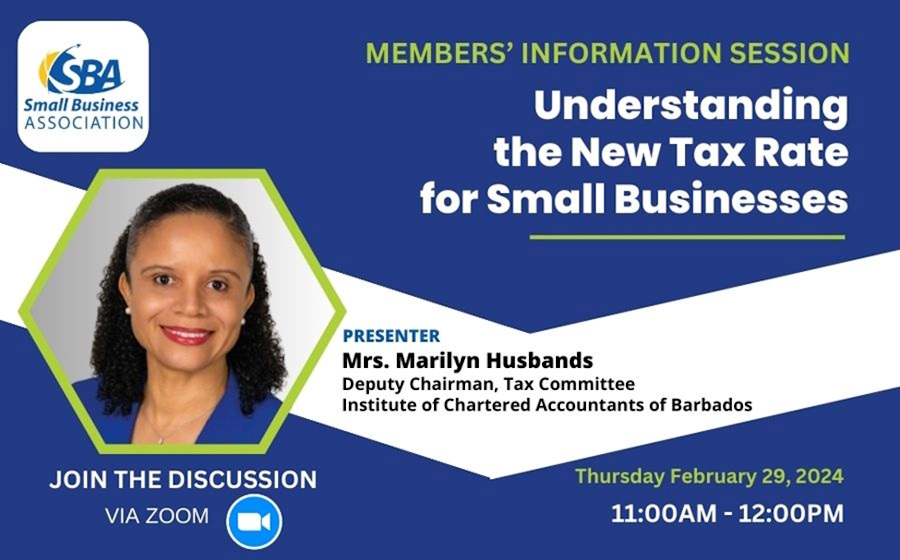
Following the recent announcement by the Minister of Finance that a new rate of 5.5% on the taxable income of a company will be applicable to small businesses from tax year 2024, the Small Business Association of Barbados recently held an educational session to discuss this new framework.

Mrs. Marilyn Husbands of the Institute of Chartered Accountants of Barbados was invited to share her thoughts with small business owners on the new regime. The presentation’s underlying theme was one of compliance considering the international regulatory framework being adopted by countries globally.

The point was underscored by the presenter that the changing landscape in the global arena will affect businesses in Barbados, and Government in its effort to respond to international financial protocols, is required to monitor business activity in the country.  Mrs. Husbands opined that there must be a line of sight of all businesses in keeping with international regulations.

The November 7, 2023, ministerial statement by the finance minister was discussed within the context of the Global Minimum Tax Deal agreed to by more than 140 countries. The new Barbados tax regime addressed tiered rates to be in effect from January 1, 2024, with the standard corporate tax rate increasing to 9%. However, the following categories were outside the scope of the new corporate rate - insurance companies, international shipping, in-scope multi-national enterprises, and small businesses registered under the Small Business Development Act.

Specifically for the small business sector the proposal is as follows:

A company whose gross income is currently below $2M and which is registered as a Small Business under the Small Business Development Act, Cap. 318C, shall be subject to a corporation tax rate of 5.5 %.

It should also be noted that subject to the stated requirements, the small business is not owned or controlled by a company with share capital or annual sales above $1 million and $2 million respectively, or by a subsidiary of that company or by a larger group. The small business should also have no agreement for the payment of fees outside of the company for managerial or other services outside of normal business operations.

The issue of consternation for most small business owners is the process of registration to access the preferential tax rate. Beneficiaries are required to register as an Approved Small Business (ASB) pursuant to the Small Business Development Act.

The Act specifically gives power to the Minister to determine an ASB:-

"Where an application referred to in subsection (1), has been made and the Minister is satisfied that the business

(a) is a small business within the meaning of section 3(1); and

(b) carries on an activity which is of significant or substantial socio-economic benefit to Barbados, the Minister may by order declare the business to be an approved small business."

This process requires the submission of the relevant application forms accompanied by the company’s incorporation documents, tax clearance certificate from the Barbados Revenue Authority, clearance from the National Insurance office, audited financial statements if gross assets or revenue exceeds $1 million, review engagement for the financial year preceding the year the application was made if gross assets or revenue do not exceed $1 million, a statement of projections for three years from an accounting organisation or a qualified accountant if the company has been in business for less than one year, and any other information requested by the Minister.

Many small firms have described the aforementioned process as onerous. One common area of concern is the challenge encountered in receiving timely supporting data from other relevant Government departments. However, as noted by the presenter, delays are often caused by incomplete information being submitted by business owners. The process should take approximately two weeks, while the confirmation of the statutory instrument should take a further two weeks.

Once the application has been approved, the confirmation is published in the Official Gazette and listed in the register of small businesses. Anecdotal information from businesses owners is that this process can take between three – six months.

Another component of this new regime that has taken many small business owners by surprise is the requirement to make monthly prepayments. It is expected that from income year 2025, all companies will be required to make monthly prepayments based on the previous year’s taxable income. Participants in the information session viewed this as a further burden to operations, requiring diligent cash flow management, which is in itself a challenge due to the uncertainty and unreliability of revenue streams.

The session discussed the trajectory of the business in relation to future cash flows, and the need by businesses to develop a strategy to ensure that the firm can protect its revenue flows. While the presenter underscored the significant socio-economic benefit provided by small firms to the development of Barbados, business owners were encouraged to pay attention to what was going on in the business environment and to remain compliant with laws and regulations.

Business Basics has been informed that since the Ministerial Statement there has been much consultation among stakeholders on the proposed tax regime and amendments are expected to incentivise the sector to benefit from the new tax rate. The business community awaits with bated breath the 2024/25 Financial Statements & Budgetary proposals to be presented by the Minister of Finance on March 18, 2024.

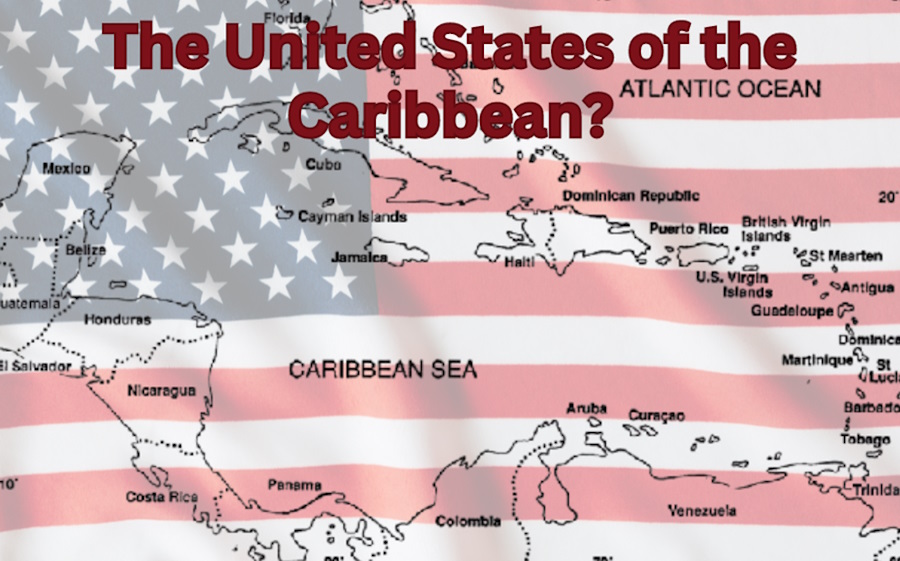
The United States of the Caribbean?

The Revised Treaty of Chaguaramas contemplated a CARICOM Single Market & Economy (CSME) that would facilitate the movement of goods, labour and capital among members states in the Caribbean Community (CARICOM) that are signatory to the CSME.

Business Basics in one of its articles last year queried ‘whither the CSME ‘due to the slow pace of implementation of the requirements to operationalise the single market and economy.  Fifty years since the integration project was conceptualised, Caribbean people are yet to benefit from the idea of regional integration. Many point to the European Union, Canada and even the United States of America as successful integration projects and wonder what the impediments to this are for the region. Whither the United States of the Caribbean?

Given this implementation paralysis as opined by the West Indian Commission (1992), Government’s recent extension of the skilled workers who could travel within the region, by three categories, seemed a drop in the proverbial bucket. The passage of this legislation in the House of Assembly just days before the Heads of Governments meeting in Guyana may serve as a good lunchtime topic for discussion among leaders but does not go far enough to fast-track what should be a vibrant single market and economy by 2024.

It was envisioned that the CSME would be implemented in two phases. Phase 1 was scheduled between 2008 and 2009, focusing on the development vision, social welfare coordination, and the establishment of regional development funds and stock exchanges. Phase 2 was scheduled for the period 2010 – 2015, aimed at harmonising taxation systems, incentives, and financial environments, implementing common policies in agriculture, energy-related industries, transport, small and medium enterprises, sustainable tourism, and establishing a CARICOM Monetary Union. However, many elements have not been fully implemented to date. In May 2014, CARICOM issued a Strategic Plan for the Community, 2015 – 2019, focusing on CSME as a priority for sustained economic development and enhanced trade and economic relations.

In this year of our Lord, 2024, we still appear to be prodding along with no clear achievable timelines for full integration. Recently, CARICOM Secretary General (SC) Dr. Carla Barnett highlighted the challenges associated with the free movement of people under the CSME. The initiative, which allowed for the free movement of goods, skills, labor, and services, was expected to be fully implemented by 2008. However, Barnett noted that the current arrangements do not grant the authority to work, but rather allow for holiday and family visits. She emphasised that the regulated movement is not necessarily efficient and that there is a need for infrastructural improvements in each member state.

Article 45 of the Revised Treaty declares that Member States commit themselves to the goal of free movement of their nationals within the community.

The following categories of wage earners are entitled to move and work freely in the Community: 

  1. Graduates of all recognised universities in the world
  2. Artistes
  3. Musicians
  4. Sportspersons
  5. Media Persons
  6. Nurses
  7. Teachers
  8. Artisans with a Caribbean Vocational Qualification
  9. Holders of associate degrees or comparable qualification
  10. Household Domestic
  11. Agricultural Worker

The recent passage of the Bill Caribbean Community (Movement of Skilled Nationals) Act, Cap. 186A in the Barbados Parliament made provision for agricultural and domestic workers, and private security officers.

With the implementation progress of the Treaty of Chaguaramas, one of the main issues recently discussed by government representatives is the lack of harmonisation of entry and exit procedures across the region.

While progress has been made to harmonise security and entry procedures, full harmonisation has not been achieved. Government officials overwhelmingly reported concerns about the differing levels of implementation with the Community, particularly in entry procedures and issuing of Skills Certificates.

Some Member States have not completed full legislative compliance for all approved categories of nationals, and the lack of harmonisation has a direct impact on how CARICOM nationals can move. There is the issue of consistent entry and exit documentation in order to facilitate data collection and information sharing about who is moving in the region. The development of Embarkation/Disembarkation Forms is a step made to standardise migration data collection. However, while there has been substantial progress, implementation remains uneven.

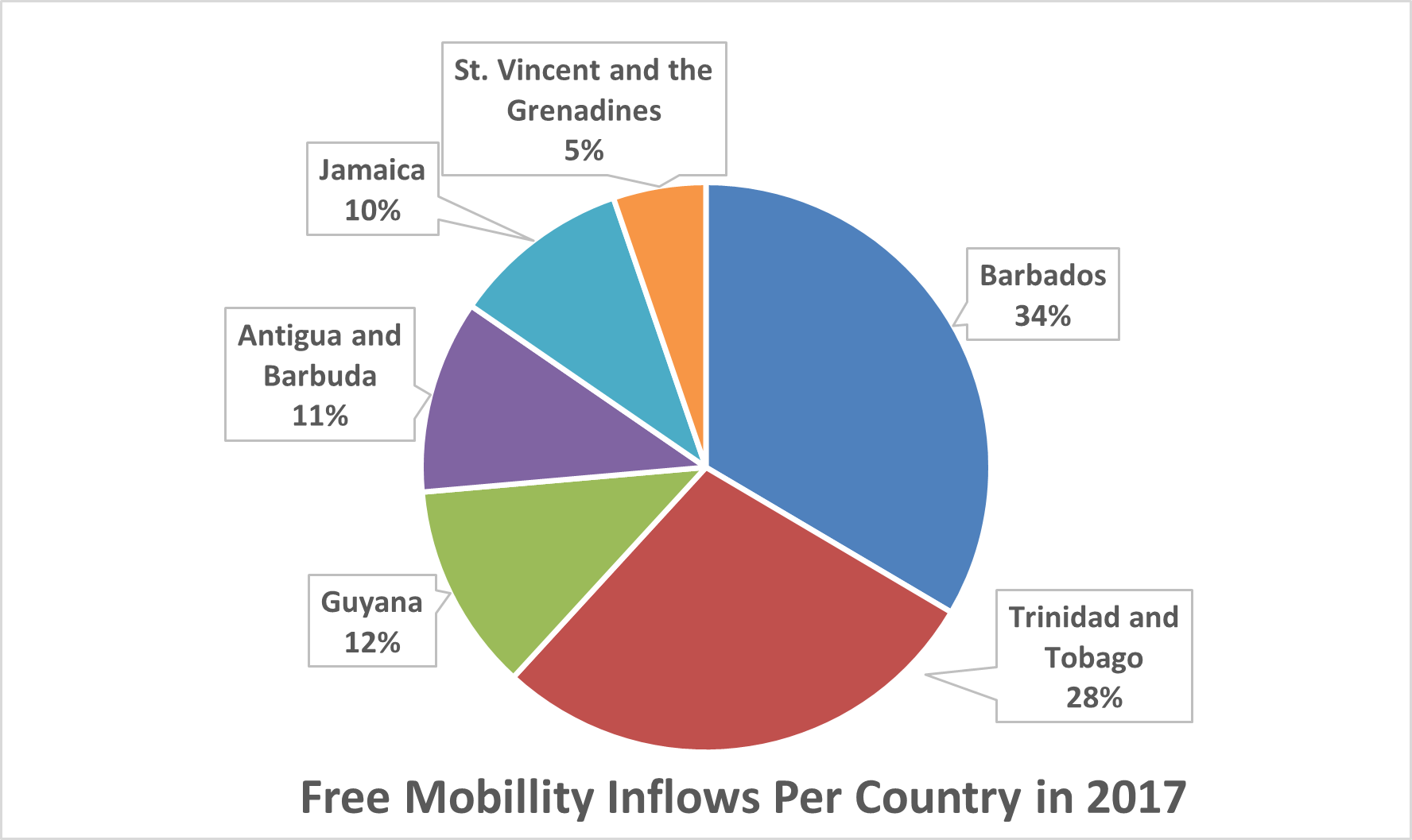
Research done which shows the mobility inflows per country tells the story of disparity.

By International Organizational for Migration (2019)

Another area germane to the success of the free movement of people is the issue of Contingent Rights. The Revised Treaty bestows several rights to Community Nationals including the right of establishment, the right to provide services, the free movement of capital and skilled Community Nationals to seek employment in other CSME participating Member States. Despite these primary rights being granted, further contingent rights were required to guarantee that these Nationals could freely enjoy them without any frustration.

There are examples of CARICOM nationals working in other territories who were unable to access social services, their spouses were unable to legally seek employment, and their children unable to access primary education, all on the same basis as citizens of the host country. These barriers frustrate the exercise of the rights conferred in the Revised Treaty.

One significant benefit of the CSME espoused by Caribbean leaders is the benefit to small businesses and the opportunity to trade.

Statistical inference based on available data, such as indicators of economic performance, unemployment rates and remittances, can be used in order to better understand this issue.

The data would suggest some key assumptions of the impact of free movement on economies.

  • Impact remains small compared to other migratory movements
  • Intraregional movements remain low compared to extraregional movements
  • Main FDI flows come from countries outside the region.

The vision therefore of the integration project is not being realised. The Heads of Government of an earlier era bequeathed this idea to our current leaders who, the evidence would suggest, are not being faithful to the cause.

Black History Month

The commemoration of Black History Month (BHM) started circa 1976, and is observed annually in the United States and Canada in February, and in the month of October in the United Kingdom. Several Caribbean countries have adopted this observance, some in February such as Barbados, Jamaica, Grenada, Guyana, among others, while Trinidad & Tobago opted for the month of November.

BHM got its genesis in the United States on account of segregation and discrimination against people of African descent. It was revealed by black scholars that in major American universities, Black or African History was rarely given much recognition since it was assumed that Sub-Saharan Africa and persons of African lineage either had no history or had not made any worthwhile contributions to human advancement. This belief resulted in the race being branded as inferior, thus the justification for segregation and discrimination.

Many historians concluded that something was wrong with this hypothesis. How can such a large segment of Sub-Saharan Africa or the African race not contribute anything to human civilisation? This opened up a new and fruitful area of sociological, historical, anthropological and archaeological studies. In a brief period, discoveries like the beginnings of early Man in the Rift Valley and sub-Saharan achievements and civilisations came to be placed in their proper provenance. At this time the black contribution to America was revealed. As a result, academia began to understand that revolutionary developments including human survival and the very beginnings of human civilisation could be traced all the way back to black Africa.

Some make the argument that industrialised countries developed their economies on the backs of black people, who continue to be a minority of these populations. This may justify the celebration of these minority groups. (In the US alone people of African descent represent approximately 14% of that country’s population). The question therefore is, what is the ethos behind celebrating BHM in the Caribbean, a region whose population is primarily African?

The facts are that major contributions have been made worldwide by persons of Black origin in various fields of expertise and accomplishments to include, Medicine, Architecture, Science, Spirituality, Culture and Sports.

The takeaway this BHM is to advocate for a rethink of how this period is viewed in the psyche of Caribbean people particularly since blacks continue to be disenfranchise and alienated from true wealth creation, in circumstances where they are in the majority.   

In Barbados as is the case with several Caribbean countries, the legislative and executive arms of Government consist only of Black people. These are the ones responsible for crafting the laws and policies, respectively, which determine the environment for business, social development, security, foreign affairs and several other areas of national development. The judiciary is similarly constructed and addresses the adjudication of the law and the treatment of justice in the country.

Community-based and civil society organisations are equally constituted and represent the opportunity to enfranchise the vulnerable, advance the development needs of ordinary citizens and advocate for equitable distribution of resources provided by the State.

In very simple terms the aforementioned structures of the society are designed to develop the country and determine the kind of environment that exist relative to law and order, the protection of human rights and citizen engagement, and the economic and social development of people. If the leaders in these areas are all of the same ethnic background and history, why then is there still discrimination, inequity and lack of empowerment. 

One thought posited by a group of entrepreneurs is that though the majority of the population is the same ethnicity, what creates the divide in the country is economic development and who controls the prospects for wealth creation. It was opined that though blacks in Barbados represent the majority in the population and control key sectors in the society, they are yet to experience economic liberation. Business owners proffer that systemic structures exist to deny black entrepreneurs access to the resources needed to develop and grow their business idea.

The several agencies that exist to provide capital seem programmed to maintain a system of deficiency in supply. Often businesses cannot pivot to the desired level of growth due to undercapitalisation, stringent securitisation, or simply a lack of the right blend of financial products to offer prospects suitable terms and conditions. Capital aside, the legislative regime for business development is punitive and not enabling to growth. Whereas good support systems exist through active business support organisations, training and other development programmes, in the absence of markets and adequate capital, the business cannot grow its market share and be sustainable. 

Some self-employed persons opined that black businesses are not creating wealth, many are simply living for the moment. Barbados could not celebrate 100 black businesses in their second or third generation of ownership. This did not bode well for wealth creation.

The statistics tell the story, as opined by a north American author.

  • Black nations don’t grow their own food
  • Black people spend 97% of their money with white businesses
  • $1.3 trillion in income is earned by black workers but there is no wealth creation
  • Blacks spend $23 billion per year on clothes; $11 billion on furniture; $3.2 billion on cellphones; $46 billion on cars; $60 billion on legal and illegal drugs; $32 billion on hair/head accessories; however, only $300 million on books.

 He further proffered that less than 2% of the wealth of the US is owned by Black people.

With the deck stacked in the favour of Black people in the region – they control the legislature, judiciary, civil society, academia, etc., - more must be done to translate this leadership to economic power. Black History Month ought not to be simply a calendar event, but a significant and profound statement made towards improving the lives of African people and transforming their history.

The Business of Banking

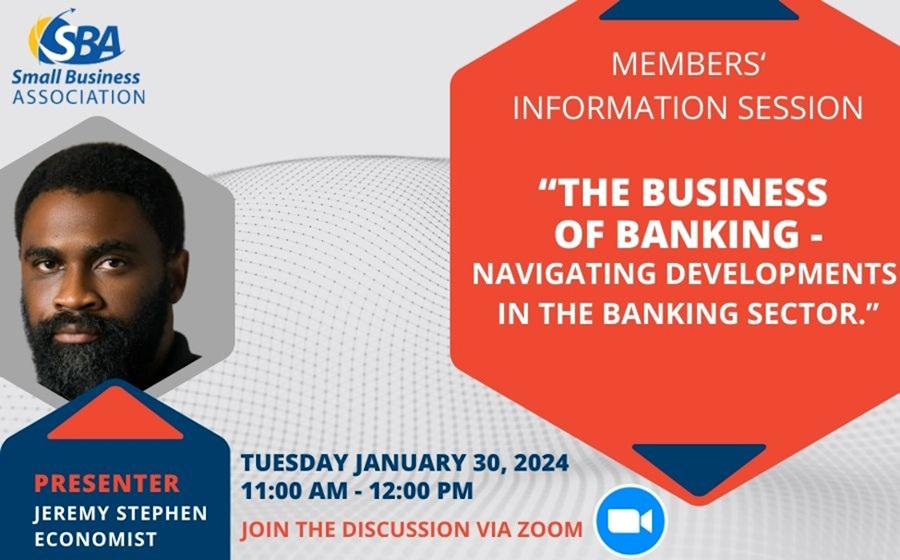
Members and partners of the Small Business Association of Barbados recently sat down in one of the association’s webinars, with economist Jeremy Stepehen, to discuss the business of banking. The session was held against the backdrop of recent efforts by some commercial banks to introduce fees for the use of the Automated Clearing House (ACH) network and the wave of fees introduced by several banks for various core banking services.

The perception shared by many in the business community is one of skepticism. Following the change in the policy regime by the Central Bank of Barbados in 2015, to remove the minimum interest rate on savings and deposits, it would appear the introduction of fees is skyrocketing out of control. This latest attempt was the proverbial straw for many consumers, resulting in national outcry and prompting the intervention of the Central Bank.

The irony in all this is the reported huge profits being earned by these financial institutions. Media reports indicate close to $200M in after tax profit in 2022 and over $225M for the first nine months of 2023 earned by commercial banks in Barbados. While we appreciate that a key goal of business is to be profitable and provide a decent rate of return to shareholders, the social democratic model of development adopted by Barbados suggests that the austerity levied on consumers on the altar of big profits is a departure from this ideology.

Economist Stephen opined that banks are viewed as a store of value, where deposits are meant to fund the loans they provide in exchange for interest. He reminded the session that commercial banks invest heavily in the ACH network to ensure that their systems are compliant and safe in a technology-driven world, and this carries a high cost.

Identifying the different types of banks, Stephen explained that commercial banks perform a retail function along with a wholesale function, providing a wide range of services for people and businesses.

Merchant banks, on the other hand, provide transactional services for business activity which include procurement services, foreign exchange and factoring, while investment banks provide capital or underwriting services for large-scale projects.

Focusing on commercial banks, with whom small businesses interact the most, the former lecturer in risk management with the UWI, Stephen noted that banks’ consistent cash flow comes through loans, where money is made through interest or transactional fees. They serve as intermediaries between individuals, businesses and government entities and help manage digital banking services and provide consultancy services. Commercial banks also handle exchanges between foreign and national currencies, and in the case of Barbados, they work with the Central Bank to facilitate these transactions.

Of particular note is the role played in sustaining Barbados’ consumer driven economy. Some 80% of economic activity in the country is generated by loans, which in turn generate economic activity and consumer spending. Commercial banks have a higher bank debt when compared to credit unions as they are the principal provider of consumer (short-term) credit in Barbados.

Small businesses were made aware of the consumer loan categories and as analysis showed, loans to small businesses were almost negligible. Home improvement and real estate dominated almost 50% of the market, while the purchase of private vehicles followed at 30%. Commercial vehicles, travel, furnishings and domestic appliances, and taxis and rented cars completed the loan portfolio of commercial banks. A self-employed person or an employee in a small firm can easier access a vehicle loan than for that firm to qualify for a business loan.

Research showed that since 2018, deposits in both banks and credit unions have risen exponentially. Explaining the low interest rates that banks pay on deposits, Stephen noted that when deposits are high, banks determine that they do not have to pay high interest rates.

Several key takeaways were observed for small businesses.

  • Banks should be used primarily for transactional purposes.
  • The Islamic style of banking is more valuable to this market. Though this model is used by a section of the Barbadian populace, with the absence of the regulatory framework to enable this regime, this style of community banking may not be a reality in Barbados for some time to come.
  • The cannabis industry is not a viable sector for investment at this stage due to issues with correspondent banking. The challenge banks in Barbados faced with their corresponding banks in the USA, is that the cannabis industry is legal at the State level, but illegal at the Federal.
  • Credit Unions continued to be stunted in their growth and ability to offer value-added services to members e.g. corporate accounts and the attendant products for businesses. In addition, the regulatory framework limits their investment options.
  • Small businesses do not benefit significantly from their relationship with banks as there is difficulty in procuring loans for equipment, expansion and business development, compared to the ease in access to a vehicle loan.  


Small firms are again being challenged to consider building a regional outlook to leverage business growth and access to capital. The local financial market has its own peculiarities which may not offer significant benefit to a sector seeking growth opportunities. Until products are introduced to unlock a percentage of the huge deposits held by individuals in financial institutions, small businesses will continue to find it difficult to pivot and go beyond their domestic limitations.

Get in Touch

Secretariat

Suite 101, Building 4
Harbour Industrial Estate
Bridgetown, Barbados

Phone

+1 (246) 228 0162

Email

theoffice@sba.bb

Follow Us

Image
Image
Image
Image