Another Small Business Week has ended with many on an emotional and intellectual high following the riveting speeches and networking opportunities shared during the week. Event after event addressed the theme of the week, with a specific focus on each age demographic involved. From the leaders in business support organisations and financial institutions, to students immerse in learning about entrepreneurship for their career planning, to policymakers task with facilitating an enabling regulatory environment, and the business owners themselves, all stakeholders were challenged to consider a Transformative Agenda that is Fit for Purpose”.
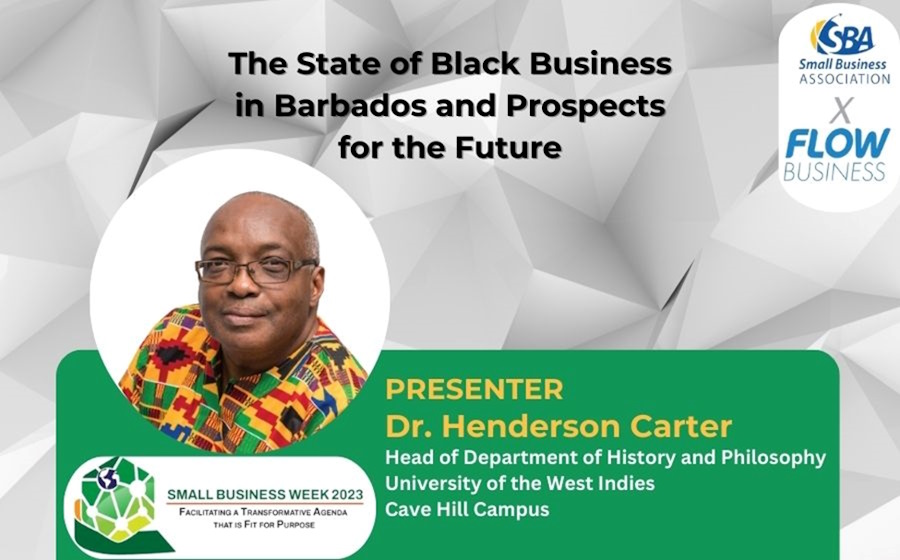
The kernels of truth shared by Dr Henderson Carter on the state of Black businesses underscored the main issue affecting many small firms in Barbados and the reasons for the lack of generational growth across Black-owned firms. Too many of the success stories from the 50s, 60s and 70s, no longer exist primarily due to a lack of succession planning and resilience building at the firm level.
Citing his extensive research on the history of black businesses in Barbados, Dr Carter proffered that the early black entrepreneurs made it in the most difficult circumstances, but succession issues contributed to the eventual failure of many of these firms. In 1960, there were 1,865 grocery/rum shops on the island, but that number fell dramatically by the 1990s.
Dr Carter cited the resilience of the early Black entrepreneurs as a key reason for their success back then. However, as the business environment changed, many of these firms did not adapt to address areas like business continuity, to give successive owners a platform on which to continue the enterprise. This resulted in many of these businesses eventually closing.
He observed that the cloud of white domination that exists can be countered by cooperation and unity within the black business sector. He cited the example of the Indo-Barbadian community that cleaves together and unites to grow their businesses. One example of this is their influence on the transportation sector.
The lack of consciousness among Black businesses was highlighted as a major reason for succession failure. Unfortunately, many family members shy away from carrying on the business opting rather to enter the civil service as their career path. Barbadians had little time for an understanding of their history, not appreciating that this knowledge helped entrepreneurs to understand the society in which they lived.
Since the focus during Small Business Week was on transformation, several simple solutions were offered by Dr Carter, that if applied, can help this generation of firms to position for sustainability.
First, entrepreneurs must invest in knowledge and research. They must listen to what workers and customers are saying about their businesses, understand how their type of business is conducted in other countries and what technology is being used. They need to know why other businesses have failed so that they can avoid the mistakes made.
Second, businesses must seek partnership with other trusted businesspersons. Our businesses tend to be one product, but growth can occur with wider partnerships with another firms. Examples of this are Goddards Enterprises Limited and Williams Industries, as well as small businesses including Seaview and The Garage in Bathsheba.
Other examples cited were taxi operators who can partner with tour guides, and agricultural enterprises who can partner with restaurants. Businesses owners must improve their networking activities, which will provide opportunities for further expansion.
A third solution is to consider the kind of person being employed in the firm. Businesses must employ people with positive attitudes, skills and ideas, who are not just interested in earning a wage but can evolve to be future shareholders of the business.
Another best practice was the recording of business activity to keep accurate data of the firm’s journey. Notes of annual meetings should be preserved, and the production of memorabilia developed throughout the life of the business, to further add value.
The final solution was the importance of memorialising the black trailblazers to demonstrate the accomplishments of those pioneers, and how they were able to transition from one endeavor to another. Plaques containing brief reviews of those trailblazers should be erected across Barbados to highlight their accomplishments and educate the population, young and old, about our history.
Examples shared included Charles Miller Austin, a blacksmith who became a successful planter and businessman, Andrew Bynoe who worked at Cave Shepherd and R L Seale before opening Carlton and A-1 Supermarket, and Everson Elcock who worked at Mannings and Company before starting his electronic contracting company. Young people must be educated to understand that they can aim for entrepreneurship even if they start by working in a job of a similar field.
Ensuring that Black businesses build succession in their firms will provide a further opportunity for young people to secure jobs through apprenticeships and job attachments. Dr Carter contended that the youth do not have to leave Barbados to find employment since opportunities abound right here through improving the ecosystem that supports entrepreneurship; stakeholders simply need to prepare for this rewarding experience.