SBA News

Protecting Local Business in a Small Open Market Economy

Within the past weeks practitioners in the transport sector have been engulfed in discussions around new entrant, Uber. Some argue the American brand will cause saturation in the small local market, while others welcomed the opportunity to participate in the international franchise. Yet others purport the increased competition will benefit the consumer and improve the standards in the sector.

Irrespective of the position taken, the issue is worthy of analysis. In a small open economy like Barbados, is the local taxi sub-sector deemed vulnerable and in need of protection or is this industry subject to the rules of free and open trade? Anyone following the recent development will admit that the issue seems localise to a section of practitioners in the industry rather than the pervasive national conversation which often follow such developments. A recent example was the entry of the McDonalds franchise in the market, which lasted for a little over a year. The market rules of supply and demand eventually determined the fate of this American fast-food chain; will the same be said for Uber?

When Global Models Meet Local Markets

The arrival of Uber is more than a corporate announcement; it is a cultural test. For decades, local taxi operators have worked within a closely regulated framework that requires special licences, fixed fare structures and adherence to national standards. Uber’s model challenges this ecosystem by introducing a platform that promises efficiency, technology and flexibility in a small market where demand and margins are already tight.

Traditional operators expressed concern that this shift could destabilise an industry that supports hundreds of livelihoods and contributes significantly to the local economy through vehicle maintenance, insurance and service-related expenditure.

The global economy is increasingly defined by digital disruption, where innovation, not protection, determines who thrives. The presence of this American brand in Barbados will challenge our readiness to adapt. Since the world will not stop evolving, it is imperative that we assist our enterprises to be agile enough to evolve with it.

For the Bajan business community, Uber’s arrival underscores a broader truth: global models will deploy even in small economies. While we look to appropriate regulation to insulate where possible, strategic innovation, the ability to deliver something that is culturally authentic, technologically current and competitively sharp, must be the response of our firms.

Innovation in Motion: pickUP Barbados

In the same transport sector where Uber has drawn headlines, local innovation has also emerged. pickUP Barbados, a ride-hailing service built by Barbadians for Barbadians, demonstrates how local entrepreneurship can rise to the challenge. Its model leverages digital technology, but grounds itself in the cultural and regulatory realities of the island, using licensed drivers, transparent pricing and a clear commitment to safety and accountability.

pickUP recognised what many global entrants overlook: that in small economies, customer trust and familiarity are powerful assets. By adapting the digital ride-hailing model to suit local needs, it has shown that competition can stimulate creativity rather than crush it.

The message here is not that Barbados should reject global brands, but that local enterprises must be equally bold in redefining their value. pickUP did not wait for protection; it built its own competitive edge.

Lessons from the Region and Beyond

Across the Caribbean, similar dynamics are unfolding. In Jamaica, Uber’s expansion into Montego Bay and Kingston prompted both government oversight and new collaborations with local taxi associations, creating hybrid models that blended international platforms with domestic compliance.

In Trinidad and Tobago, Ridelink carved out its own space by focusing on safety verification and real-time tracking, addressing consumer concerns about legitimacy and trust.

Meanwhile, Guyana’s emerging digital-transport platforms have shown that competition, when properly managed, can lead to sector-wide improvement rather than destruction.

Globally, small economies that have succeeded in integrating international competition, such as New Zealand and Singapore, share one common feature: they view global entrants as benchmarks to rise to, not barriers to resist. Their SMEs thrive because national culture celebrates innovation rather than protectionism.

The Modern Bajan Business Mindset

So, what defines the “Bajan business model” in this new era? It is not a rigid formula but a mindset. A modern Bajan enterprise is locally grounded, globally aware and digitally fluent.

It draws strength from cultural pride but does not mistake tradition for strategy. It competes on customer experience, trust and adaptability. It understands that innovation is not only about new technology, but about continuous improvement, how products are made, how customers are served and how value is communicated.

This mindset demands that we shift our thinking. When competition comes, the first response cannot be for protection through policy prescription. Yes, some sectors are more vulnerable than others and should be insulated through regulatory support. Some industries also serve a national good and must enjoy certain preferences. The real solution lies in agility, creativity and collaboration. Policy can create guardrails, but competitiveness comes from within.

For advocates of MSME development, there is the obligation to support the most vulnerable, the small operators who risk being left behind. This must be supported by a commitment to help traditional businesses transform. Barbados’ development depends on all sectors advancing together.  

This month of Independence invites us to reflect on what economic freedom truly means. National pride is not only about flying the flag; it is about economic self-determination. To be proudly Bajan in 2025 means building businesses that can compete internationally while keeping their roots firmly planted in Barbadian soil.

The challenge before us is how do we empower our entrepreneurs to rise to the challenge. pickUP Barbados is not an anomaly; it is evidence of what is possible when cultural pride meets strategic execution. If we can replicate that spirit across sectors, from retail and hospitality to manufacturing and digital services, Barbados can prove that small size is no limitation to big ambition.


Building Confidence Before Capital: Igniting an Investment Culture

Barbados is set to host the Innovation & Growth Market 200 (IGM 200) conference this week to mobilise both small & medium enterprises, and investors to build out an equity market for SMEs to raise capital for their businesses.

A project developed by the Ministry of Energy & Business, the Barbados Stock Exchange and the Small Business Association of Barbados, the initiative is part of a series of educational and development activities to strengthen the local Junior Market and ignite an investment culture among Barbadians. For sure the question on the minds of many during this week’s event will be, does Barbados possess the investment culture needed to sustain a junior market and unlock the growth potential of SMEs?

While the IGM 200 provides a welcome platform for innovation and growth, its true success will depend not merely on infrastructure, but on the collective mindset of businesses, investors and policymakers.

Lesson from other Markets

Jamaica’s thriving Junior Market offers a compelling regional example of what can happen when cultural readiness meets institutional support. Equally, lessons from countries including the United Kingdom, Australia and Canada reveal that the foundations of a successful junior market are often laid years before launch, through targeted efforts to build confidence, literacy and participation in equity investment.

When Jamaica launched its Junior Market in 2009, few could have anticipated its long-term impact. Fifteen years later, the platform has transformed into one of the most successful junior exchanges in the region. Companies listed on the Junior Market have paid out significant dividends over time, reflecting strong investor participation and business performance.

This outcome was not the result of luck. Jamaica acted early and decisively to create an enabling culture around investment and entrepreneurship. The government and the Jamaica Stock Exchange (JSE) recognised that SMEs needed both financial and psychological incentives to list. The introduction of a 10-year corporate tax relief scheme for listed Junior Market companies, full exemption for five years and 50% relief for the next five – gave small firms a tangible reason to formalise, adopt good governance and seek public capital.

In the UK, adult households exhibit very low participation in equity investment. According to a recent analysis, UK adults hold only around 8% of their wealth (excluding pensions) in equities and mutual funds, the lowest figure among G7 nations. This suggests that even when structural mechanisms exist for junior listings, a lack of widespread investor engagement can limit their full economic impact.

Australia provides a contrasting example. The 2023 study by the Australian Securities Exchange (ASX) found that more than half of Australian adults held investments outside of home and superannuation in 2023. Other relevant findings include the fact that the number of on-exchange investors rose from 6.6 million to 7.7 million, equating to roughly 38% of Australian adults. These shifts reflect a broader cultural acceptance of equity ownership, particularly among younger and female cohorts.

Canada’s junior public markets serve as another instructive example, showing that diversity of listing regimes and consistent policy support for growth firms can help build resilience. A recent “Junior Public Markets Health Check” found that Canada’s junior markets have maintained listing levels more effectively than senior exchanges, underscoring that junior listing regimes fill a key gap in SME financing and can foster growth when culture and structure align.

The cultural element is unmistakable. In each of these markets, success correlated strongly with an early commitment to investor literacy, transparent regulation, and celebration of entrepreneurial risk-taking as a public good. Equity investment became a social norm, not an elite activity.

Implications for Barbados

Barbados is well-positioned to emulate these lessons. The country’s SMEs already represent the backbone of the economy; however, a deeply conservative investment culture, shaped by decades of reliance on traditional banking and informal finance, has limited the use of equity as a growth instrument.

The IGM 200 initiative therefore arrives at a pivotal time. It provides the platform for a national conversation on developing an investment culture and the impetus to begin the transformation. The key question is not whether Barbados can create a market, but whether it can create market readiness, among both businesses and investors.

SMEs will need to recognise that listing is more than raising capital: it is a strategic action that demands governance, transparency, investor readiness and public credibility. Support programmes, mentorship, governance training, investor-relations training will help ensure that companies are not only eligible but are equipped to perform as public entities.

Investors, in turn, will need to reconceptualise equity participation. Public education campaigns can play a transformative role. When citizens understand the connection between investing and national growth, when they can point to listed local companies as success stories, participation rates rise.

Building Confidence Before Capital

The next step is building confidence, confidence among entrepreneurs to list, and confidence among investors to invest. Structural design is essential, but cultural groundwork is what sustains momentum.

This groundwork involves practical steps: policy incentives that reward early listings; public recognition for successful SME issuances; integration of investment education into the school curriculum; and partnerships with media to normalise equity participation. The goal should be to make investment in local enterprise as commonplace as having a savings account.

Other countries’ experiences confirm that such cultural shifts are achievable. In Australia, public-awareness campaigns supported by regulators and financial institutions helped normalise stock ownership, while in Jamaica, visible fiscal incentives and mentoring embedded listing within the SME journey. Canada’s balance between regulatory credibility and accessibility shows that investor confidence can coexist with entrepreneurial agility.

Barbados can build on these examples by treating investment culture as part of its national development agenda. The IGM 200 offers a catalyst, a focal point for aligning policy, education and enterprise; the true measure of success will be whether, five years from now, the conversation about investment culture has evolved from caution to participation.

Are We Really Moving the Needle on Improving Access to Finance

The issue of access to finance by small businesses has been a matter of public conversation in recent weeks. The national discussion has been elevated following the recent launch of the European Union’s ‘Bridge’ Grant programme to support green transition and digital transformation projects presented by small and medium enterprises. The structure of the grants programme is unlike the many calls for proposals of the recent past. No longer will SMEs be able to access 100% funding but qualifying applicants will receive up to 60% of project costs as grant funding and must provide the remaining 40% themselves.

While this design is meant to encourage accountability and shared investment, it has created a serious barrier for many otherwise promising enterprises. For a micro or small business, securing the remaining 40% can be near impossible without resorting to high-interest loans, personal savings, or informal borrowing, each of which carries significant financial risk.

This new structure has been described by many small firms as further compounding the access to finance issues experienced by the sector with the traditional financial providers. Where many international and regional programmes previously offered full or near-full grant support for approved projects, recent funding rounds have shifted towards co-financing models.

For years, the issue of access to finance has stood as one of the most persistent obstacles facing SMEs in Barbados and across the Caribbean. Despite decades of policy discussions, strategic plans, and new financial products, the lived experience of many small business owners remains the same, it is still extraordinarily difficult to access affordable, timely funding.

A Wider Regional Dilemma

Regionally, SMEs continue to grapple with arguably, one of the most stubborn barriers to small business growth. From Trinidad and Jamaica to St Lucia and Barbados, business owners cite financing as the single greatest obstacle to growth and innovation. The Inter-American Development Bank (IDB) reports that firms across the region face high borrowing costs, limited access to credit, and steep collateral requirements, with 72% of Barbadian firms identifying collateral as a major or very severe obstacle to doing business.

The problem, however, is not uniquely Barbadian. In Jamaica and the Eastern Caribbean, entrepreneurs encounter comparable bottlenecks when seeking commercial loans, often finding that financial institutions prioritise low-risk lending and impose collateral demands that smaller, asset-light firms simply cannot meet. Where some territories have made incremental progress is in the establishment of credit guarantee schemes and dedicated MSME financing facilities, such as Jamaica’s Development Bank and Trinidad and Tobago’s ExporTT and NEDCO initiatives. These mechanisms help de-risk lending for banks and expand financing channels for small businesses, models that Barbados could scale up locally.

The broader challenge, though, is systemic. Grant mechanisms such as the EU’s 60–40 co-financing rule are well-intentioned but mismatched to the financial realities of small enterprises. For many SMEs, having to raise 40% of project costs upfront can mean taking on unsustainable debt or abandoning viable proposals altogether. The issue is not the absence of support, but rather the accessibility of that support.

A more collaborative regional approach could help. By expanding pooled credit guarantees, harmonising SME lending frameworks, and building shared financial literacy programmes, Caribbean economies could begin to close the gap between policy ambition and practical access. The message is clear: improving access to finance must move beyond rhetoric to structural reform, because innovation, entrepreneurship, and competitiveness all depend on it.

Barbados’ Reality Check

Barbados has made visible progress. The Enterprise Growth Fund Limited (EGFL) continues to provide debt and equity financing to SMEs; the Central Bank of Barbados supports financial inclusion initiatives; and the Government recently secured a US$50 million loan from the IDB to expand MSME finance.

However, despite these mechanisms, the impact has been uneven. Many micro businesses, particularly those in retail, hospitality, creative industries, and light manufacturing, remain outside the reach of formal credit. They are too large for microfinance, too small for commercial banking, and too risky for equity investors.

This is why the current co-financing requirement is so problematic: it assumes the existence of a functioning credit ecosystem that, for many SMEs, simply does not exist.

If Barbados is serious about unlocking SME growth, there must be a rethink on the structure and complement of financing tools. Several pragmatic steps could be considered:

  1. Introduce a national co-financing fund — a revolving facility to bridge the percentage funding gap for approved projects, allowing micro and small firms to access full grant potential without incurring high-interest debt.
  2. Expand guarantee schemes — enabling banks to lend smaller sums at manageable risk and including the credit unions in the pool of financing options, to give SMEs access to short-term liquidity for project implementation.
  3. Target flexibility for vulnerable groups — women-led and youth enterprises should qualify for reduced co-financing thresholds or blended finance models combining smaller grants with technical assistance.
  4. Strengthen advisory and mentorship support — pairing funding with financial literacy, business planning, and export readiness training to increase long-term sustainability.

Such reforms would not only help SMEs implement projects but also improve repayment performance, job creation, and productivity, outcomes that benefit the entire economy.

At its core, the question remains: are we moving the needle in improving the access to finance? Progress has been made, yes, but not yet at the scale or inclusiveness required. Financing cannot remain a privilege for those with collateral or cash on hand. It must become a deliberate strategy to empower those who keep the economy moving – small retailers, artisans, service providers, and innovators.

Without addressing the financing gap, innovation and entrepreneurship are stifled, at a time when Barbados needs both. To realise a truly vibrant small business sector, this issue of access to finance must be addressed once and for all. Access to finance should not be another hurdle to jump by aspiring SMEs, it should be the bridge that carries small businesses from survival to sustainability.

Celebrating the first Student Cohort in the Entrepreneurial NVQ Programme

Maintaining a school’s programme training scores of fifth formers annually, since 2009, is no small feat. Cognisant that marketing and innovation are key function of business, the Small Business Association jumped at the opportunity to collaborate with partners to develop the National Vocational Qualification in Small Business Entrepreneurship level 2, to add value to its schools’ programme.

The NVQ was recently rolled out amongst 75 fifth form students from several secondary schools with 68 of these completing the programme and being deemed competent to receive the qualification. For the first time in the local educational system, students were able to access a new qualification certifying their entrepreneurial training.

It is a truism that the country’s young people are brimming with ideas, from hand-crafted goods to digital services with global reach. The question remains: How do you turn these ideas into something tangible and ensure the ideas are not just passion, but recognised skill? This NVQ administered by the SBA and certified by the TVET Council, has proven to be that initiative which offers young people something fresh: a practical, certified pathway into business — not just in theory, but in competence.

For a student in secondary school, the NVQ does more than fill a curriculum slot.

The eight mandatory units of the qualification, covering retail products and services, small business planning, sourcing and managing finances, using business technology, sustainable business operation, workplace communication, health and safety, and working in culturally diverse environments — reflect the real demands of operating a business in Barbados today.

Imagine Maria, 17, in Speightstown. She attends a local secondary school and has long been selling handmade jewellery online. Thanks to this new NVQ, she can now attach her informal business acumen to a nationally recognised certificate. She refines her business plan, learns how to manage finances, develops a tech-savvy approach to selling, and integrates health and safety standards into her workspace. By completing the programme, she holds both a digital storefront and a credential that signals competence to suppliers, lenders and partners.

Why it matters (students and the national economy)

Micro, small and medium enterprises (MSMEs) dominate the Barbadian private sector. Research shows that 92.2% of formal enterprises in Barbados are micro or small, and that MSMEs generate nearly 48% of private-sector employment. This is not a niche. It is the economy.

For students, the NVQ bridges the gap between academic study and the real world of commerce. Whether they ultimately start their own business, join the family trade, or enter employment in a larger company, the entrepreneurial mindset is now recognised, not just encouraged. The certification formalises what many young Barbadians already do informally, create, innovate, and lead, but elevates it with structured competency and credibility.

Too often, entrepreneurial education ends with a business idea and a presentation. The NVQ changes that as it expects candidates to demonstrate actual competency. That shifts the narrative from “could I be an entrepreneur?” to “I am qualified in entrepreneurship.”

As students complete tasks anchored in real-life business functions, they cultivate confidence and credibility. They gain experience in planning, finance, technology, sustainability and communication. These are leadership muscles. They learn to ask: How will I source finance? Who is my customer? How will I run this business profitably? How do I communicate across cultures? These are not textbook questions; they are pragmatic questions.

For the economy of Barbados, this means that the next generation of business owners will be better equipped. They will bring certified competence, not just enthusiasm.

Regional comparison

Across the Caribbean, NVQ and Caribbean Vocational Qualifications have become powerful tools for workforce development. Jamaica’s HEART/NSTA Trust certifies tens of thousands annually in fields ranging from hospitality to ICT. Entrepreneurship training is typically embedded within broader technical programmes, often offered to post-secondary or adult learners rather than integrated into the secondary school curriculum.

Similarly, in Trinidad and Tobago, the National Training Agency (NTA) provides CVQs in business-related fields, but its entrepreneurship modules are primarily targeted at older cohorts, particularly those already working in industry or enrolled in tertiary education.

What sets the Barbados NVQ in Small Business Entrepreneurship apart is its direct engagement with students at the secondary level. Unlike many regional programmes, this NVQ was designed through partnership with the SBA and industry players, with a specific focus on nurturing entrepreneurial thinking early. It positions entrepreneurship not as an afterthought to technical education, but as a standalone, certified competency.

This early intervention model provides young people with both skills and credentials before they enter the labour market, giving them a tangible head start and establishing Barbados as a regional pioneer in youth-focused entrepreneurship certification.

The NVQ is deliberately practice-driven, aligning with the entrepreneurial realities of Barbados’ MSME landscape. It recognises the informal business activity that already exists among young people, whether online sales, creative industries, services or small trading, and offers a way to validate and strengthen those skills.

A call to students, partners, and policymakers

To students: the NVQ is not just another qualification. It is an entrepreneurial passport.

To parents, educators and mentors: this is a chance to nurture entrepreneurship from within communities.

Finally, to policymakers and business-community partners: the NVQ in Small Business Entrepreneurship is a clear signal. It shows that Barbados is serious about youth, innovation and growth. The next step is to match certification with resources, investment, mentorship and opportunity.

The NVQ in Small Business Entrepreneurship is more than a credential. It is a launch pad for Barbados’ future business leaders. It offers students tangible skills, real-world relevance, and regional mobility. It equips them to step beyond the classroom, to create businesses, drive innovation, and build futures.

A Tax on the Little Guy: Why Barbados’ Car Rental Levy Misses the Mark

Barbadians are heavily taxed! Most taxpayers do not mind paying their fair share of taxes once they can reap the social benefits and enjoy a decent standard of living. Additionally, the introduction of levies that go towards a national good can be appreciated. The Queen Elizabeth Hospital levy, the Garbage & Sewage tax and the most recent Resilience & Regeneration levy added to national insurance payments, are some examples of taxpayers contributing to the national good.

The problem emerges when the services at the QEH have not improved, evidence in the plethora of complaints daily on the call-in programmes and the anecdotal evidence from citizens on a weekly basis. The lack of improvement in the garbage collection around the country – in preparing this article there are communities in rural parishes that have not had a garbage collection in three weeks. But not to digress.   

Of late the consistent imposition of levies, has become overbearing with many Barbadians complaining and justifiably so, about the current tax regime. It is ironic that the InterAmerican Development Bank’s 2025 – 2030 Country Strategy proffered that private domestic and foreign investment is challenged by several hurdles, including “a burdensome tax structure”.

This is why the introduction of a rental car levy which does not only penalise visitors but locals alike, is difficult the comprehend. From this month, Government is moving forward with the Car Rental Levy, originally scheduled for 1 October 2025, and now expected to be implemented by 15 October 2025. This levy will replace the visitor permit and will charge BBD$5 per day for a maximum of seven days, adding up to BBD$35 per rental. While this levy is a sector-specific tourism charge, targeting only vehicle rentals rather than general tourism spend, it still represents a disproportionate hit to smaller operators, many of whom are already struggling to recover from the economic pressures of the COVID-19 pandemic.

For some time, Governments have sought to tax heavily the tourism sector, which has been touted as the ‘cash cow’ for the economy. This however has been buttressed by the provision of several incentives for major tourism players to balance any increases in operating costs.

Large operators including international hotel chains, resort groups, etc., can absorb the cost of a modest levy across multiple revenue streams. Their pricing structures are more flexible, allowing them to fold the levy into room rates without significantly affecting demand. They may also benefit from greater economies of scale and marketing reach, insulating them from marginal increases in cost. These large players already benefit from a range of concessions under the Tourism Development Act and related investment legislation. These include duty-free concessions, tax rebates, and other incentives that reduce their operating costs. A major resort can absorb or redirect costs because it has multiple revenue streams: rooms, restaurants, spa services, golf courses, events, and tour commissions. A small car rental operator has none of that.

The problem is that small rental firms operate with tighter margins and less pricing power. A levy that adds even a small percentage to their costs can erode profitability. They are often more vulnerable to shifts in visitor behaviour, such as tourists opting for bigger brands with bundled rates or more perceived value. These small businesses are also challenged from the underground economy – those individuals who are not legally registered, do not pay their taxes but provide vehicle rentals to locals and sometime visitors, at prices net of any taxes or levies.

Imagine a modest car rental business based in St. Philip, with ten vehicles primarily serving budget-conscious returning nationals and mid-range tourists. A five-day rental now carries a BBD$25 levy. If the operator’s net profit per booking was previously BBD$40, the levy wipes out more than half of that margin. A price increase risks losing those customers altogether. Meanwhile, a large resort with hundreds of guests and in-house luxury amenities, remains untouched by this levy.

Any economist worth they salt will argue that revenue generated by smaller players like the Airbnb, rentals firms and the like, will contribute directly to the economy as these transactions circulate in real time in the economy. Persons are employed, products and services are procured and yes, taxes are paid, faster. This is why it makes good economics and even political sense by an administration to insulate smaller players since they are not benefiting from incentives and concessions and have the potential to contribute more directly to economic growth.

Global research, including reviews commissioned by the Welsh Government, shows that the impact of a tourism levy depends on its structure. Flat per-day taxes without exemptions or tiering tend to hit small, locally owned operators hardest. Why?

  • Smaller companies cannot spread costs across large volumes.
  • Larger firms can use tax concessions or pricing power.
  • Flat-rate levies take a bigger percentage bite from smaller margins.
  • Customers are more price sensitive at the lower end of the market.

This is why many jurisdictions exempt or scale down levies for micro and small businesses to protect their competitiveness.

International experience also shows that transparent use of levy revenue builds trust. Several countries in Europe use income from levies to support infrastructure, conservation, and marketing, all clearly reported. Levy allocations are published annually in municipal budgets.

By contrast, in Barbados, there has been no clear commitment on how revenues from the Car Rental Levy will be allocated or reported. This lack of clarity creates understandable concern, as businesses are wary of measures that take without showing tangible return.

This isn’t just an accounting issue. Over time, the cumulative pressure on small operators can push them out of the market, allowing larger, well-capitalised players to consolidate even more control over the tourism economy. The end result? Less local ownership, reduced community benefit, and a less inclusive tourism sector.

The United States of the Caribbean

From the Caribbean Free Trade Association conceptualised in 1965 to the Caribbean Community in 1973, it has taken regional governments over 50 years to give effect to the idea of free movement of people in the Caribbean. Four CARICOM countries agreed at the last Heads of Government meeting to adopt the regime of free movement, effective October 1, 2025. For Barbados this appears shrouded in legitimacy since local legislation has not been passed to give legal standing to the regional declaration. Time does not permit a discussion on the need for Government to better manage its legislative agenda. Suffice it to say, the issue of regional integration transcends sheer public relations. The integration project is too germane to the advancement of the region’s economies and the sustainability of micro, small and medium enterprises.

Not to digress, the work towards regional integration is simply taking too long. This effort by four countries, though to be lauded, is a mere drop in the bucket towards achieving the vision of the architects of CARICOM. It is true that economist George Beckford once posited that the people of the Caribbean have long been integrating, the fact is the legal and regulatory framework is needed to fully enable this ideal.  

Successful integration projects include Canada, the European Union and even the United States of America. In the case of the US, a Texan whose cultural expression is so diametrically opposite to a New Yorker, has the same rights under the constitution as someone from New York, they are both American. Why not work towards the United States of the Caribbean?

The fact is that Caribbean states have been experiencing anaemic growth for decades with Guyana as the only outlier due to their recent oil find. Regional economies need to pivot economic integration, and private sector firms need the entire Caribbean as a market to grow. Opportunities for trade, the movement of capital and citizens finding employment opportunities are key benefits of the integration project.

Though Barbados’ economy grew by 2.5% in the first half of 2025, driven largely by tourism, construction, business services, and retail, the MSME sector can play a leading role, but is inhibited by labour shortages and rising business costs.

The Free Movement Regime offers an opportunity to relieve some of these pressures. With services accounting for 86% of Barbados’ employed labour force, including over 19,000 in wholesale and retail, and more than 15,000 in accommodation and food services, the ability to recruit from a wider regional talent pool can help small businesses in these areas expand capacity, reduce recruitment delays, and manage wage pressures more effectively.

By eliminating the need for skills certificates and work permits, free movement lowers administrative barriers and expands the recruitment pool for firms. Employers in hospitality, retail, construction, agriculture, and the creative industries can now source workers more flexibly and cost-effectively.

While the labour dimension is the most immediate, the Regime also has wider economic implications that should not be overlooked.

Each new CARICOM national is not only a worker but also a customer. They require housing, food, transport, clothing, financial services, and recreational activities, all areas where MSMEs are heavily represented. In this sense, the regime contributes directly to the expansion of the domestic marketplace. Migration research indicates that freer movement of persons within CARICOM tends to stimulate demand in receiving economies by enlarging resident populations and increasing everyday consumption. The International Organisation for Migration has noted that such regimes support economic linkages and service consumption across borders.

The CARICOM Commission on the Economy has long argued that labour mobility is central to building a more competitive and integrated regional economy. By reducing barriers, free movement helps to lay the groundwork for deeper collaboration and investment. While hard data on direct SME-to-SME partnerships is still scarce, the underlying logic is clear: an environment where people can move easily is also one where business networks, training opportunities, and investment flows can develop more naturally. Over time, this translates into stronger cross-border supply chains and collaborative ventures that benefit small firms as much as larger ones.

The Organisation of Eastern Caribbean States experience offers important lessons. Free movement has been in place there for more than decades, and surveys show broad public support for the arrangement. While empirical data specific to MSMEs remains limited, the trend suggests that mobility strengthens opportunities for individuals and helps smooth labour shortages in critical sectors.

Importantly, migration experts caution against fears of uncontrolled migration into Barbados. Evidence suggests that such flows are generally modest, targeted, and skills driven. Dr Olivia Smith, a regional mobility specialist, has argued that migration under free movement is most often linked to specific trades such as plumbing, electrical work, and hospitality, precisely the sectors where Barbados’ small businesses face gaps.

This balanced perspective is vital. The free movement regime is not a silver bullet, nor will it instantly transform the small business landscape. But it does provide an enabling environment, one where MSMEs can more easily access talent, benefit from additional consumers, and position themselves to take advantage of regional opportunities.

The student of regional integration has been taught one fundamental truth about all the integration projects globally – each had a catalyser that propel participating nations to work together for their survival. Whether it was to prevent a war, to avoid a devastating famine or some other catastrophe, there was a major event that served as the stimulus for countries to abandon nationalism and insularity to create a political and/or economic union to protect the overall block of countries.

The same cannot be said for the Caribbean. From the early 1960s to now the region is still toying with the idea of integration. Several political speeches and promises later, the region has still not been able to realise full integration.

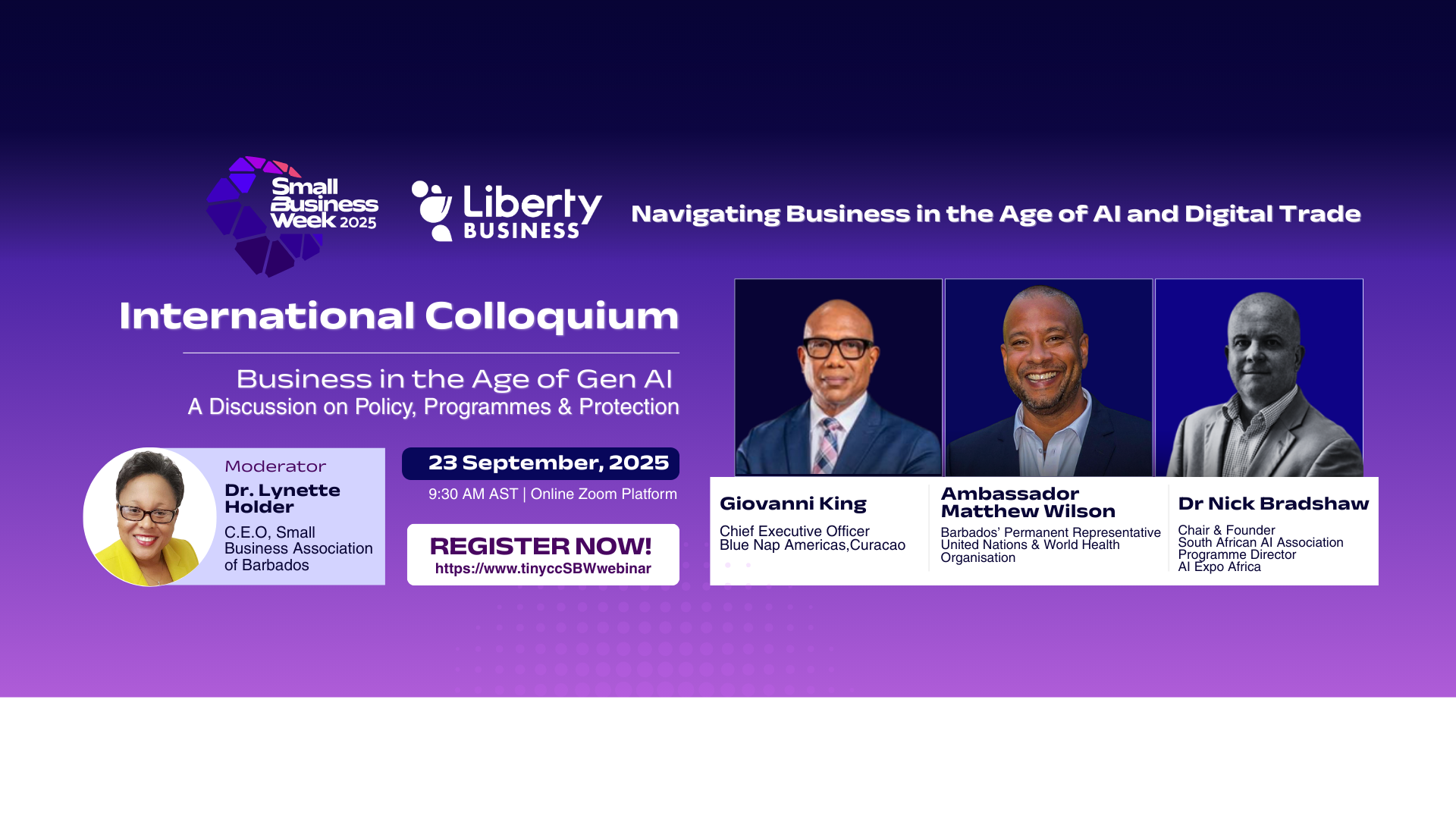
Colloquium on AI Policies, Programmes & Protection

The international colloquium held during Small Business Week 2025 highlighted the issues of artificial intelligence from three pertinent areas – polices, programmes and protection.

Generative AI is no longer a distant concept reserved for large corporations or advanced economies, it is here, transforming industries and reshaping the way small businesses operate. The three presenters who shared during the colloquium offered well researched yet practical solutions for businesses to navigate the current technological revolution.

Ambassador Matthew Wilson, Barbados’ Permanent Representative to the WTO and UN in Geneva, proffered that policies and governance frameworks must evolve to support small businesses in this digital era. He reminded participants that while AI offered enormous potential, it also raises concerns about job displacement, data privacy, cybersecurity, and fairness in access. Yet, rather than fearing AI, policymakers and MSMEs alike must learn to work with it, regulate it responsibly, and harness its potential for growth.

Drawing on global research, Ambassador Wilson shared striking statistics: businesses adopting generative AI have reported on average, a 39% reduction in costs and a 45% increase in revenue, largely from automating routine tasks, improving supply chain efficiency, and enhancing customer interactions. For small businesses, often limited by time and resources, this represents a once-in-a-generation opportunity to level the playing field with larger firms.

However, he cautioned that these benefits cannot be realised without deliberate policy action. From Geneva, he highlighted ongoing global efforts at the WTO, ITU, UNESCO, and other international organisations aimed at creating ethical, inclusive, and secure frameworks for AI adoption. He stressed that policies must “speak to each other” across local, regional, and international levels to avoid fragmentation and to ensure that small states like Barbados are not left behind.

He also highlighted persistent challenges, such as the global digital divide, weak cybersecurity frameworks, and limited AI literacy in many developing regions. For the Caribbean, this means investing in reliable internet infrastructure, digital skills training, and regional approaches to governance.

Dr. Nick Bradshaw, founder of the South African AI Association, provided a deep dive into the programmes and initiatives that can guide responsible adoption of AI across regions like Africa and the Caribbean. His presentation drew parallels between emerging markets, showing that the challenges, and opportunities, are remarkably similar.

Dr. Bradshaw introduced the concept of the AI paradox: that the same factors making AI transformative also posed risks. For instance, while AI can create efficiency and new opportunities, it can also disrupt traditional jobs, increase misinformation, and overwhelm governments struggling to regulate a rapidly evolving technology.

To navigate this paradox, Bradshaw argued, responsible AI programmes are essential. In South Africa, his association has built one of the largest B2B AI practitioner communities on the continent, bringing together businesses, policymakers, NGOs, and academics to share knowledge, establish ethical standards, and support inclusive growth. These efforts are already producing results, including detailed studies of Africa’s AI ecosystem, mapping over 6,000 companies working with AI across 20 countries.

Bradshaw explained that while the ecosystem is growing, investment has lagged behind. Less than 1% of global AI venture capital flows to Africa, and similar patterns exist in the Caribbean. This mismatch between growth and funding is a challenge, but also an invitation for governments and investors to step up.

He also stressed that education and skills development are critical. With much of Africa’s population under 25, experimentation with tools like ChatGPT and generative AI is creating grassroots innovation. He suggested that the Caribbean, with its young, tech-savvy population, may be poised for a similar “leapfrog moment.”

Perhaps one of his most striking insights was the transformation of data centres into the “offices of the future.” Instead of physical call centres, Bradshaw described a world where thousands of AI-driven agents can operate virtually inside server racks, reshaping the world of work. This shift, he noted, will be both disruptive and full of opportunities for those prepared to adapt.

While the first presenters discussed policies and programmes, Mr. Giovanni King, CEO of Blue NAP Americas, tackled the third pillar of the colloquium: protection. His presentation centred on data, the fuel of AI, and the critical importance of safeguarding it through strong digital infrastructure

King explained that while the Caribbean is home to multiple data centres, Blue NAP Americas remains the only Tier 4 facility in the region, providing world-class reliability and security. His vision goes beyond individual facilities: he called for a regional network of interconnected data centres, enabling governments and businesses to manage and protect their data within friendly jurisdictions, strengthening both sovereignty and resilience.

For Mr. King, data protection starts with classification. Not all data is created equal, and businesses must know what is public, what is confidential, and what must remain sovereign. By classifying data, MSMEs can ensure that their most valuable assets, such as financial information, customer records, or national heritage content, remain secure and within their control.

He also highlighted the human dimension of cybersecurity. Despite advanced encryption and firewalls, the weakest link remains the individual employee. Training, awareness, and a culture of vigilance are therefore essential for SMEs, who are often the most vulnerable to phishing, fraud, and AI-driven attacks.

Mr. King noted that AI itself is raising the stakes, with cybercriminals increasingly using AI tools to generate sophisticated scams and deepfakes. For small firms, the first line of defence is awareness, knowing what risks exist and where to turn for help.

He stressed that Caribbean nations must work together. Just as tourism has flourished through regional cooperation, so too must the region collaborate on digital infrastructure. With over 40 million people across the Caribbean, the collective potential is far greater than any one country acting alone.

Taken together, their insights offered a clear roadmap: the Caribbean must embrace innovation boldly, regulate wisely, and protect vigilantly. For MSMEs, this means not only experimenting with new technologies but also staying informed, connected, and prepared for a digital future that is already upon us.

AI Action Plan to be Developed by all Stakeholders

Small Business Week (SBW) 2025 has started, and similar to previous years, the theme for this year’s week of activities is expected to inform national conversations, influence policy decisions, and key development programmes for the small business sector.  Navigating Business in the Age of AI and Digital Trade portends a strategic conversation on where business is today and what should be the response to the pervasiveness of artificial intelligence. Business owners, policymakers and leaders in the small business ecosystem can ill afford to ignore the disruptive nature of generative AI on the business landscape.

SBW is known to have had some wins in the past. The recently launched Junior Stock Exchange project was a product of the 2019 SBW action plan. Several agencies pursued digitalisation interventions following the 2020 and 2021 week of activities, which elevated the use of technology in business at the heights of the COVID-19 pandemic. At the 2022 State of the Sector conference, during that year’s week of activities, the then Minister of Innovation, Science & Technology was challenged with addressing the issue of geo blocking, due to the impediments by small firms in trading their goods and services on major platforms such as Google, Facebook and YouTube.

SBW has evidently provided a platform for national discourse on the issues affecting the sector and the action plans needed to address these issues. This year will be no different. The small business community therefore welcomes the ideas posited by the Minister of Energy and Business and the clarion call made for stakeholders to coalesce around a set of innovative, timely and relevant solutions to enable small and medium enterprises to maximise the current opportunities of AI.

The following represents a summary of the proposals posited by Senator Cummins.

These are the things that we need to be able to deliver as policy implementation activities. We need to build digital guardrails. We need to write the rules of digital trade for Barbados, including championing a CARICOM digital trade chapter, which allows us to harmonise e-signatures, e-invoicing, consumer protection, and data flows. We need to advocate for SME carve-outs in World Trade Organisation negotiations so that global rules reflect small economy realities. We need to be able to publish a Barbados AI starter rule book, to help guide SMEs map European Union in particular, because we have an economic partnership agreement, and we trade a lot with Europe. An EU AI Act compliance timeline for our exporters to launch with our business community, to go beyond sponsorship, to be launched with our business community an AI skill’s voucher scheme to subsidise MSME upscaling.

We need also with our financing partners to establish a Barbados digital SME fund, blending grants and concessional loans, offering tax credits to businesses investing in approved digital solutions. For policymakers, we need to build the infrastructure. We need to work on harmonizing the regional rules, to pair governance with enablement and not with frustration. For the business sector, we need to open supply chains to SMEs. We need to pay small suppliers promptly, governments too. We need to provide mentorship and co-fund training. For technology partners, we need to design affordable, small island-ready tools, train entrepreneurs in AI and e-commerce, ensure transferability, transparency, and interoperability, For the small business community, digitise one process at a time. We've established it's overwhelming. We cannot do it all at once. Use AI responsibly as a co-pilot, but not as a replacement. Expand into regional markets before scaling globally.

For the Small Business Association, be the digital navigator, provide guidance, curate a trusted vendor list, run a digital help desk to support the community. Champion training, partner with universities and tech firms to deliver AI and digital literacy workshops; represent SME voices in those CARICOM and WTO spaces where we need to have an advocate. Facilitate finance, and we commit to doing so on our part from the ministry’s side, in particular with regards to Fund Access and Trust Loans. Connect members to the digital SME fund once it is established and mentor access to concessional loans. Promote regional collaboration. Build a Caribbean SME knowledge network with sister associations and make that global.

For the Caribbean with the right digital rails, modern trade rules and scales, Caribbean SMEs can expand exports, energise our creative industries to tell our stories, drive regional integration, build businesses, create generational wealth that we pass on to those who come behind us. But without action, SMEs will continue to face compliance costs that they cannot meet, connectivity gaps that they cannot bridge, payment frictions that they cannot overcome. We cannot wait for that to change, we have to either change it or lead it, but those are our only two options.

The road is not waiting for us; AI and digital trade are rewriting the rules of business in real time. This is our moment to act, government under the Ministry of Energy and Business will lay that rails and help to write the rules. We will advocate with you. We will open the doors to ensure that you are sitting at all the right tables, alongside us as stakeholder partners.

Businesses you need to open the doors and mentor SMEs.

Technology partners need to adopt the solutions that meet our realities.

Entrepreneurs you will need to continue to innovate boldly.

The SBA needs to guide, train, and advocate for SMEs every step of the way.

If we work together, Barbados and the Caribbean will not simply participate in this space, we have the ability to lead it.

We anticipate that following the several speeches, discussions and engagement, SME stakeholders will be emboldened to adopt these and other ideas to maximise the potential of AI. As in previous development periods, new technologies present new opportunities for growth and innovation. These opportunities must not be missed.

Be Cautious about Fear-based Narrative of Artificial Intelligence

Be Cautious about Fear-based Narrative of Artificial Intelligence

Plans for Small Business Week 2025 continue apace under the theme of Navigating Business in the Age of AI and Digital Trade. The relevance of this theme has become even more acute as several pundits and authors have of late pointed to the dangers of Generative AI and the prophesy of the negative consequences of this new technology. The godfather of AI recently sounded the alarm in an article by Futurism that his creation was about to unleash massive unemployment.

Geoffrey Hinton, the Nobel prize winning scientist who earned the title of Godfather of AI based on his work on neural networks, opined that tech CEOs are deluding themselves and others for proclaiming the positive outcomes that will be derived from AI. Hinton argues that the wealthy will use Gen AI to replace workers, causing an increase in profits for the rich while the majority of citizens will become poorer. This outcome he ascribed to the capitalist system that exists.

As the Futurism article wrote, the timeline for the jobs Armageddon was not offered however Hinton did proffer that the technology would become super intelligent, able to outthink the smartest human, in about five to 20 years.

Why there should be caution about fear-based narratives on AI:

 1. Historical Parallels Suggest Overreaction Is Common

Every major technological revolution, from the printing press to electricity, from the steam engine to the internet sparked fear about job losses and societal collapse.

The reality though is that these technologies have transformed economies, created new industries, and elevated living standards. One example is the automated teller machine (ATM) which was expected to destroy bank teller jobs. Instead, ATMs have changed the role of tellers and led to more bank branches being established particularly in rural areas.

The lesson to be learnt is that technology displaces some jobs but often creates new kinds of work yet to be imagined.

 2. The Future Is Not Pre-determined

Hinton speaks of Gen AI as if the world is on a fixed track toward doom. The fact is that technological outcomes are shaped by policy, ethics, and human agencies, not by fate. Governance and guardrails are the purview of people. Many institutions, from the European Union’s AI Act to corporate AI ethics teams, are already building frameworks for safe and equitable deployment.

Human adaptability must be celebrated. Societies have repeatedly shown resilience and creativity in adapting to massive change. Instead of resorting to panic, what is needed is participation and education. Fear disengages; agency empowers.

 3. Exaggerating AI's Capabilities Is Risky in Itself

Claims about “superintelligence” arriving in 5 – 20 years are speculative, and largely based on intuition, not evidence. AI today is narrow and brittle: large language models like GPT-4 can write essays but cannot reason robustly, form intentions, or understand causality. There is a false equivalence being spun in the narrative of fear. AI is often anthropomorphised, assuming it is on a path to human-like cognition, this is more narrative than science. Overhyping AI’s power may cause governments or corporations to give too much control to tools that aren't nearly as competent as claimed.

There is a need to be cautious about claims that inflate AI’s threat as much as those that minimise it.

 4. Work ≠ Human Worth

Hinton argued that AI-induced unemployment will rob people of their dignity and purpose, but this assumes work is the only source of those things.

Post-work societies are not dystopian by default: a society where basic needs are met and people are free to pursue creativity, learning, care work, or community service could be more humane, not less.

There is a cultural shift needed – the problem is not AI. It is society’s narrow definition of value as "wage labour" That is a social construct, not a law of nature.

What if AI gives the opportunity to redefine success, meaning, and purpose?

5. Fear-Based Narratives Can Lead to Regressive Policy

Doom scenarios can push governments to over-regulate innovation and kill useful progress (e.g., in medicine, education, climate modeling). Doom scenarios can empower monopolies (like OpenAI or Google) under the pretense that only they can “safely” develop AI leading to less transparency and more centralisation. These scenarios can also suppress open research in favour of secrecy, which reduces accountability and democratic oversight.

Caution about AI should not become authoritarianism about AI.

There is need to be cautious about AI panic. History shows tech fear is often overblown. Previous tech revolutions disrupted jobs and created prosperity. The future is not fixed. Governance, ethics, and agency matter more than inevitability. AI capabilities are overhyped; large language models are not close to superintelligence.

Human dignity does not depend on jobs alone, meaning can be found beyond wage labour.

Fear can lead to bad policy and the risk of overregulation, monopolies, and public panic.

Gen AI is neither salvation nor apocalypse; it is a tool, and like all powerful tools, it requires wise handling, not fear or fatalism.

One can be cautious of AI, but that does not mean being afraid of A. It means being wise about how it is used, and just as wise about how it is talked about it.

Get in Touch

Secretariat

Suite 101, Building 4
Harbour Industrial Estate
Bridgetown, Barbados

Phone

+1 (246) 228 0162

Email

theoffice@sba.bb

Follow Us

Image
Image
Image
Image