SBA News

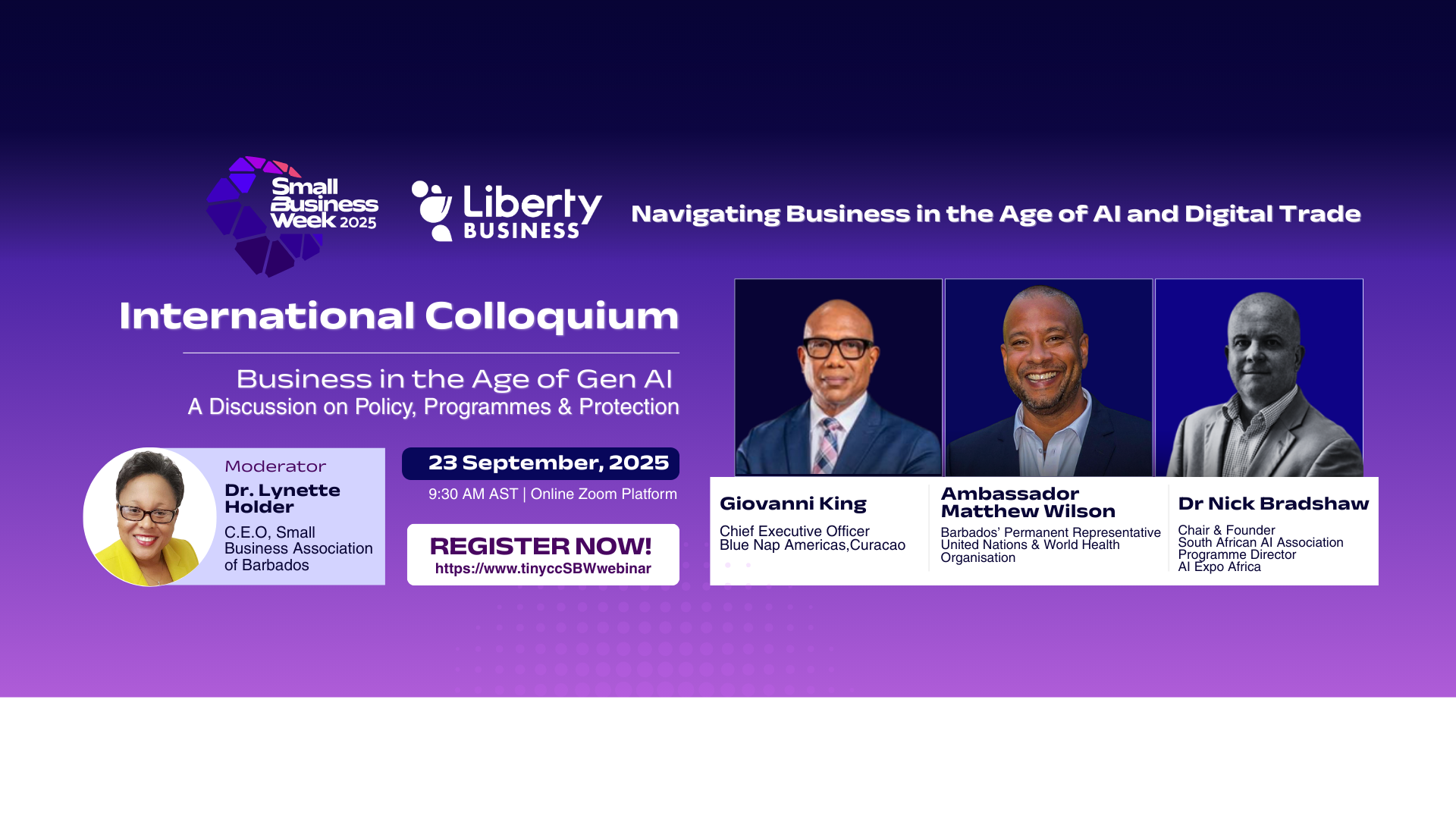
Colloquium on AI Policies, Programmes & Protection

The international colloquium held during Small Business Week 2025 highlighted the issues of artificial intelligence from three pertinent areas – polices, programmes and protection.

Generative AI is no longer a distant concept reserved for large corporations or advanced economies, it is here, transforming industries and reshaping the way small businesses operate. The three presenters who shared during the colloquium offered well researched yet practical solutions for businesses to navigate the current technological revolution.

Ambassador Matthew Wilson, Barbados’ Permanent Representative to the WTO and UN in Geneva, proffered that policies and governance frameworks must evolve to support small businesses in this digital era. He reminded participants that while AI offered enormous potential, it also raises concerns about job displacement, data privacy, cybersecurity, and fairness in access. Yet, rather than fearing AI, policymakers and MSMEs alike must learn to work with it, regulate it responsibly, and harness its potential for growth.

Drawing on global research, Ambassador Wilson shared striking statistics: businesses adopting generative AI have reported on average, a 39% reduction in costs and a 45% increase in revenue, largely from automating routine tasks, improving supply chain efficiency, and enhancing customer interactions. For small businesses, often limited by time and resources, this represents a once-in-a-generation opportunity to level the playing field with larger firms.

However, he cautioned that these benefits cannot be realised without deliberate policy action. From Geneva, he highlighted ongoing global efforts at the WTO, ITU, UNESCO, and other international organisations aimed at creating ethical, inclusive, and secure frameworks for AI adoption. He stressed that policies must “speak to each other” across local, regional, and international levels to avoid fragmentation and to ensure that small states like Barbados are not left behind.

He also highlighted persistent challenges, such as the global digital divide, weak cybersecurity frameworks, and limited AI literacy in many developing regions. For the Caribbean, this means investing in reliable internet infrastructure, digital skills training, and regional approaches to governance.

Dr. Nick Bradshaw, founder of the South African AI Association, provided a deep dive into the programmes and initiatives that can guide responsible adoption of AI across regions like Africa and the Caribbean. His presentation drew parallels between emerging markets, showing that the challenges, and opportunities, are remarkably similar.

Dr. Bradshaw introduced the concept of the AI paradox: that the same factors making AI transformative also posed risks. For instance, while AI can create efficiency and new opportunities, it can also disrupt traditional jobs, increase misinformation, and overwhelm governments struggling to regulate a rapidly evolving technology.

To navigate this paradox, Bradshaw argued, responsible AI programmes are essential. In South Africa, his association has built one of the largest B2B AI practitioner communities on the continent, bringing together businesses, policymakers, NGOs, and academics to share knowledge, establish ethical standards, and support inclusive growth. These efforts are already producing results, including detailed studies of Africa’s AI ecosystem, mapping over 6,000 companies working with AI across 20 countries.

Bradshaw explained that while the ecosystem is growing, investment has lagged behind. Less than 1% of global AI venture capital flows to Africa, and similar patterns exist in the Caribbean. This mismatch between growth and funding is a challenge, but also an invitation for governments and investors to step up.

He also stressed that education and skills development are critical. With much of Africa’s population under 25, experimentation with tools like ChatGPT and generative AI is creating grassroots innovation. He suggested that the Caribbean, with its young, tech-savvy population, may be poised for a similar “leapfrog moment.”

Perhaps one of his most striking insights was the transformation of data centres into the “offices of the future.” Instead of physical call centres, Bradshaw described a world where thousands of AI-driven agents can operate virtually inside server racks, reshaping the world of work. This shift, he noted, will be both disruptive and full of opportunities for those prepared to adapt.

While the first presenters discussed policies and programmes, Mr. Giovanni King, CEO of Blue NAP Americas, tackled the third pillar of the colloquium: protection. His presentation centred on data, the fuel of AI, and the critical importance of safeguarding it through strong digital infrastructure

King explained that while the Caribbean is home to multiple data centres, Blue NAP Americas remains the only Tier 4 facility in the region, providing world-class reliability and security. His vision goes beyond individual facilities: he called for a regional network of interconnected data centres, enabling governments and businesses to manage and protect their data within friendly jurisdictions, strengthening both sovereignty and resilience.

For Mr. King, data protection starts with classification. Not all data is created equal, and businesses must know what is public, what is confidential, and what must remain sovereign. By classifying data, MSMEs can ensure that their most valuable assets, such as financial information, customer records, or national heritage content, remain secure and within their control.

He also highlighted the human dimension of cybersecurity. Despite advanced encryption and firewalls, the weakest link remains the individual employee. Training, awareness, and a culture of vigilance are therefore essential for SMEs, who are often the most vulnerable to phishing, fraud, and AI-driven attacks.

Mr. King noted that AI itself is raising the stakes, with cybercriminals increasingly using AI tools to generate sophisticated scams and deepfakes. For small firms, the first line of defence is awareness, knowing what risks exist and where to turn for help.

He stressed that Caribbean nations must work together. Just as tourism has flourished through regional cooperation, so too must the region collaborate on digital infrastructure. With over 40 million people across the Caribbean, the collective potential is far greater than any one country acting alone.

Taken together, their insights offered a clear roadmap: the Caribbean must embrace innovation boldly, regulate wisely, and protect vigilantly. For MSMEs, this means not only experimenting with new technologies but also staying informed, connected, and prepared for a digital future that is already upon us.


AI Action Plan to be Developed by all Stakeholders

Small Business Week (SBW) 2025 has started, and similar to previous years, the theme for this year’s week of activities is expected to inform national conversations, influence policy decisions, and key development programmes for the small business sector.  Navigating Business in the Age of AI and Digital Trade portends a strategic conversation on where business is today and what should be the response to the pervasiveness of artificial intelligence. Business owners, policymakers and leaders in the small business ecosystem can ill afford to ignore the disruptive nature of generative AI on the business landscape.

SBW is known to have had some wins in the past. The recently launched Junior Stock Exchange project was a product of the 2019 SBW action plan. Several agencies pursued digitalisation interventions following the 2020 and 2021 week of activities, which elevated the use of technology in business at the heights of the COVID-19 pandemic. At the 2022 State of the Sector conference, during that year’s week of activities, the then Minister of Innovation, Science & Technology was challenged with addressing the issue of geo blocking, due to the impediments by small firms in trading their goods and services on major platforms such as Google, Facebook and YouTube.

SBW has evidently provided a platform for national discourse on the issues affecting the sector and the action plans needed to address these issues. This year will be no different. The small business community therefore welcomes the ideas posited by the Minister of Energy and Business and the clarion call made for stakeholders to coalesce around a set of innovative, timely and relevant solutions to enable small and medium enterprises to maximise the current opportunities of AI.

The following represents a summary of the proposals posited by Senator Cummins.

These are the things that we need to be able to deliver as policy implementation activities. We need to build digital guardrails. We need to write the rules of digital trade for Barbados, including championing a CARICOM digital trade chapter, which allows us to harmonise e-signatures, e-invoicing, consumer protection, and data flows. We need to advocate for SME carve-outs in World Trade Organisation negotiations so that global rules reflect small economy realities. We need to be able to publish a Barbados AI starter rule book, to help guide SMEs map European Union in particular, because we have an economic partnership agreement, and we trade a lot with Europe. An EU AI Act compliance timeline for our exporters to launch with our business community, to go beyond sponsorship, to be launched with our business community an AI skill’s voucher scheme to subsidise MSME upscaling.

We need also with our financing partners to establish a Barbados digital SME fund, blending grants and concessional loans, offering tax credits to businesses investing in approved digital solutions. For policymakers, we need to build the infrastructure. We need to work on harmonizing the regional rules, to pair governance with enablement and not with frustration. For the business sector, we need to open supply chains to SMEs. We need to pay small suppliers promptly, governments too. We need to provide mentorship and co-fund training. For technology partners, we need to design affordable, small island-ready tools, train entrepreneurs in AI and e-commerce, ensure transferability, transparency, and interoperability, For the small business community, digitise one process at a time. We've established it's overwhelming. We cannot do it all at once. Use AI responsibly as a co-pilot, but not as a replacement. Expand into regional markets before scaling globally.

For the Small Business Association, be the digital navigator, provide guidance, curate a trusted vendor list, run a digital help desk to support the community. Champion training, partner with universities and tech firms to deliver AI and digital literacy workshops; represent SME voices in those CARICOM and WTO spaces where we need to have an advocate. Facilitate finance, and we commit to doing so on our part from the ministry’s side, in particular with regards to Fund Access and Trust Loans. Connect members to the digital SME fund once it is established and mentor access to concessional loans. Promote regional collaboration. Build a Caribbean SME knowledge network with sister associations and make that global.

For the Caribbean with the right digital rails, modern trade rules and scales, Caribbean SMEs can expand exports, energise our creative industries to tell our stories, drive regional integration, build businesses, create generational wealth that we pass on to those who come behind us. But without action, SMEs will continue to face compliance costs that they cannot meet, connectivity gaps that they cannot bridge, payment frictions that they cannot overcome. We cannot wait for that to change, we have to either change it or lead it, but those are our only two options.

The road is not waiting for us; AI and digital trade are rewriting the rules of business in real time. This is our moment to act, government under the Ministry of Energy and Business will lay that rails and help to write the rules. We will advocate with you. We will open the doors to ensure that you are sitting at all the right tables, alongside us as stakeholder partners.

Businesses you need to open the doors and mentor SMEs.

Technology partners need to adopt the solutions that meet our realities.

Entrepreneurs you will need to continue to innovate boldly.

The SBA needs to guide, train, and advocate for SMEs every step of the way.

If we work together, Barbados and the Caribbean will not simply participate in this space, we have the ability to lead it.

We anticipate that following the several speeches, discussions and engagement, SME stakeholders will be emboldened to adopt these and other ideas to maximise the potential of AI. As in previous development periods, new technologies present new opportunities for growth and innovation. These opportunities must not be missed.

Be Cautious about Fear-based Narrative of Artificial Intelligence

Be Cautious about Fear-based Narrative of Artificial Intelligence

Plans for Small Business Week 2025 continue apace under the theme of Navigating Business in the Age of AI and Digital Trade. The relevance of this theme has become even more acute as several pundits and authors have of late pointed to the dangers of Generative AI and the prophesy of the negative consequences of this new technology. The godfather of AI recently sounded the alarm in an article by Futurism that his creation was about to unleash massive unemployment.

Geoffrey Hinton, the Nobel prize winning scientist who earned the title of Godfather of AI based on his work on neural networks, opined that tech CEOs are deluding themselves and others for proclaiming the positive outcomes that will be derived from AI. Hinton argues that the wealthy will use Gen AI to replace workers, causing an increase in profits for the rich while the majority of citizens will become poorer. This outcome he ascribed to the capitalist system that exists.

As the Futurism article wrote, the timeline for the jobs Armageddon was not offered however Hinton did proffer that the technology would become super intelligent, able to outthink the smartest human, in about five to 20 years.

Why there should be caution about fear-based narratives on AI:

 1. Historical Parallels Suggest Overreaction Is Common

Every major technological revolution, from the printing press to electricity, from the steam engine to the internet sparked fear about job losses and societal collapse.

The reality though is that these technologies have transformed economies, created new industries, and elevated living standards. One example is the automated teller machine (ATM) which was expected to destroy bank teller jobs. Instead, ATMs have changed the role of tellers and led to more bank branches being established particularly in rural areas.

The lesson to be learnt is that technology displaces some jobs but often creates new kinds of work yet to be imagined.

 2. The Future Is Not Pre-determined

Hinton speaks of Gen AI as if the world is on a fixed track toward doom. The fact is that technological outcomes are shaped by policy, ethics, and human agencies, not by fate. Governance and guardrails are the purview of people. Many institutions, from the European Union’s AI Act to corporate AI ethics teams, are already building frameworks for safe and equitable deployment.

Human adaptability must be celebrated. Societies have repeatedly shown resilience and creativity in adapting to massive change. Instead of resorting to panic, what is needed is participation and education. Fear disengages; agency empowers.

 3. Exaggerating AI's Capabilities Is Risky in Itself

Claims about “superintelligence” arriving in 5 – 20 years are speculative, and largely based on intuition, not evidence. AI today is narrow and brittle: large language models like GPT-4 can write essays but cannot reason robustly, form intentions, or understand causality. There is a false equivalence being spun in the narrative of fear. AI is often anthropomorphised, assuming it is on a path to human-like cognition, this is more narrative than science. Overhyping AI’s power may cause governments or corporations to give too much control to tools that aren't nearly as competent as claimed.

There is a need to be cautious about claims that inflate AI’s threat as much as those that minimise it.

 4. Work ≠ Human Worth

Hinton argued that AI-induced unemployment will rob people of their dignity and purpose, but this assumes work is the only source of those things.

Post-work societies are not dystopian by default: a society where basic needs are met and people are free to pursue creativity, learning, care work, or community service could be more humane, not less.

There is a cultural shift needed – the problem is not AI. It is society’s narrow definition of value as "wage labour" That is a social construct, not a law of nature.

What if AI gives the opportunity to redefine success, meaning, and purpose?

5. Fear-Based Narratives Can Lead to Regressive Policy

Doom scenarios can push governments to over-regulate innovation and kill useful progress (e.g., in medicine, education, climate modeling). Doom scenarios can empower monopolies (like OpenAI or Google) under the pretense that only they can “safely” develop AI leading to less transparency and more centralisation. These scenarios can also suppress open research in favour of secrecy, which reduces accountability and democratic oversight.

Caution about AI should not become authoritarianism about AI.

There is need to be cautious about AI panic. History shows tech fear is often overblown. Previous tech revolutions disrupted jobs and created prosperity. The future is not fixed. Governance, ethics, and agency matter more than inevitability. AI capabilities are overhyped; large language models are not close to superintelligence.

Human dignity does not depend on jobs alone, meaning can be found beyond wage labour.

Fear can lead to bad policy and the risk of overregulation, monopolies, and public panic.

Gen AI is neither salvation nor apocalypse; it is a tool, and like all powerful tools, it requires wise handling, not fear or fatalism.

One can be cautious of AI, but that does not mean being afraid of A. It means being wise about how it is used, and just as wise about how it is talked about it.

Small Business Week focuses on artificial intelligence and digital trade

Each year, the Small Business Association of Barbados hosts its flagship event, Small Business Week (SBW), a time when the national spotlight is turned towards entrepreneurs and the vital role they play in shaping the economy and society. Now in its 22nd year, SBW has matured into more than just a calendar event. It has become a platform for dialogue, for celebration, and for charting the course of the small business sector in Barbados.

This year’s theme, Navigating Business in the Age of AI and Digital Trade, reflects both the challenges and opportunities that the 21st-century marketplace presents. Across the world, artificial intelligence is no longer a futuristic idea; it is a present reality, reshaping industries, transforming customer expectations, and redefining the way commerce is conducted. For a small, open economy such as Barbados, these shifts cannot be ignored. They demand that our micro, small and medium enterprises (MSMEs) adapt quickly, build capacity, and take full advantage of the opportunities emerging from digital transformation.

For many business owners, the idea of artificial intelligence can feel abstract or distant, something reserved for large corporations or developed economies. Yet AI is already here in Barbados, embedded in the tools and platforms used daily—from social media algorithms that help target customers, to online banking systems, to chatbots that enhance customer service. For small businesses, these technologies present real opportunities to reach wider markets, reduce costs, and improve efficiency.

At the same time, they bring new challenges. MSMEs often face resource constraints, making it difficult to invest in digital solutions or to access the skills needed to harness them. Policy frameworks and financial systems must therefore keep pace, ensuring that small firms are not left behind. This is where SBW plays a critical role—by facilitating the conversation, raising awareness, and helping both businesses and policymakers appreciate what is at stake.

SBW is a time for honest discussion about the obstacles MSMEs face: access to finance, regulatory burdens, training gaps, and the pace of technological change. By creating a national forum, the SBA ensures that these issues are not only voiced but placed on the agenda for action. Many of the themes explored in previous years—sustainability, resilience, transformative growth—have since found their way into government policy, donor programmes, and the strategies of private sector organisations.

This impact demonstrates the value of SBW beyond the celebrations. It is not simply a showcase; it is a driver of policy influence, education, and collective action.

The importance of SBW is not unique to Barbados. Across the world, such initiatives are recognised for their contribution to economic development and resilience.

In the United States, the Census Bureau notes that small businesses make up the majority of firms and employ nearly half of the private sector workforce, underscoring why their national Small Business Week is seen as central to economic recognition and policy dialogue. Similarly, the American Entrepreneurship Foundation highlights that these firms contribute significantly to innovation and community development, demonstrating the long-term value of celebrating and supporting them.

In the United Kingdom, small businesses account for 99 per cent of all companies, contributing more than half of private sector turnover. A recent report by Capital on Tap emphasised that SMEs are “the backbone of the UK economy,” showing how initiatives such as Small Business Week are vital in raising awareness of their challenges and promoting tailored support

In Canada, a Central York business support organisation describes small businesses as a “force behind economic growth,” responsible for employing millions and driving innovation. Their Small Business Week is framed not just as recognition, but as an economic development strategy to ensure these firms continue to thrive.

By drawing parallels with these international examples, it is evident that Barbados’ SBW performs a similar function—it is a deliberate intervention designed to strengthen one of the most productive and dynamic sectors of the economy.

The 2025 SBW theme will challenge stakeholders to think differently about the future. Digital trade—the exchange of goods and services enabled by electronic means—is expected to dominate global commerce in the coming decade. For small businesses in Barbados, this means competing not just with the shop across town, but with suppliers halfway across the world. It also unlocks possibilities that previous generations of entrepreneurs could only dream of.

A small agro-processor in St Philip can now sell products to Diaspora communities abroad through e-commerce platforms. A young creative in St James can market services to clients in North America using digital marketplaces. A tour operator in Christ Church can reach potential visitors through online experiences, long before they set foot on the island. The common thread in all these examples is the ability to leverage technology to overcome scale and geography.

To fully benefit, the ecosystem must be ready. Financial institutions must provide products tailored for digital enterprises. Policymakers must design a regime that protects consumers
without stifling innovation. Training institutions must equip the workforce with the digital skills required, and businesses must be willing to embrace change, to experiment, and to adopt new ways of working.

During SBW, entrepreneurs will be exposed to discussions that bring clarity to these issues, helping them to see not just the global trends, but how those trends apply locally. They will hear from experts and practitioners who can translate abstract concepts like AI into practical applications for marketing, accounting, customer service and production.

At the same time, the week provides visibility. For small firms that often struggle to gain attention in a crowded marketplace, SBW offers a platform to showcase achievements, build networks,
and attract customers and partners. The exposure can be transformative, especially for younger enterprises seeking to establish themselves.

Importantly, SBW also strengthens partnerships. By involving stakeholders across government, finance, academia, and development agencies, it fosters collaboration that extends well beyond the week itself. Initiatives sparked during SBW often continue into the following year, creating sustained impact.

What is the correlation between vehicle tint and crime?

Many small firms are breathing a sigh of relief following the announcement that the date for enactment of the tint legislation has been deferred to December this year. Some are even hoping for a complete repeal of the legislation.

The Road Traffic Act, last amended in 1984, has been updated to meet modern law enforcement needs, bringing Barbados in line with other Caribbean nations, including Jamaica, Trinidad and Tobago, and Antigua and Barbuda. Although initially announced in September 2024 with a grace period for compliance, the implementation of the tint rules was delayed until this month.

Small courier firms, agricultural suppliers, food vans, caterers, florists and many other general services that have panel vans, trucks and other commercial vehicles have been hastily trying to adjust their tint to comply with the law. The fact is, today, many are still noncompliant.

In many instances, the tint on vehicles is factory-applied. Consumers are unsure how such vehicles would be treated due to the difficulty in removing the tint. More so, the few small businesses with the capacity to remove tint have been inundated due to the demand from customers trying to meet the September 1 deadline.

Beyond the humbug that many feel this legalisation has brought to their operations, the question of relevance has been on the lips of many in the past few months. Barbadians are generally of the view that there is no positive correlation between the lack of tint on a vehicle and crime reduction. Accordingly, this issue has been treated with sheer comedy and was the punch line for many calypsos during the recent Crop Over festival.

While it is appreciated that a myriad of approaches will be needed to arrest the crime situation, there is a general belief among citizens that those behind the crime ring are known to the authorities. Targeting law-abiding citizens who use tint to cool their vehicles, to protect valuables and for personal privacy appears to be a draconian exercise by 

All right-thinking Barbadians agree that everything must be done to support police officers in the discharge of their duty and ensure road safety. Some posited that regulations could have been put in place requesting citizens to lower their windows when stopped by law enforcement officers for random checks or other inspections. Additionally, the necessary law could be introduced to ensure the windscreen of the vehicle bore no tint, as is the case in other countries.

Canada
In Canada, window-tinting regulations are generally among the strictest in the world. The key area of restriction is the front of the vehicle. In most provinces, any form of tinting on windscreens and the front driver and passenger windows is either completely prohibited or heavily restricted. By contrast, rear windows are subject to more relaxed rules, allowing for greater personalisation and driver comfort.Authorities emphasise that these rules are not driven by aesthetics or even crime prevention, but primarily by safety considerations. The central argument is that clear front windows ensure that law enforcement officers can maintain visibility into vehicles during traffic stops or roadside checks. This transparency allows officers to assess driver behaviour and identify potential risks, particularly in situations where safety may be compromised.

Europe
In Europe, regulations vary considerably from one country to another, yet there is a broadly consistent standard for the front of vehicles. Typically, windscreens must allow at least 75 per cent of visible light transmission, while front side windows must generally allow 70 per cent or more. The rear of the vehicle — including rear side windows and rear windscreens — is usually subject to far fewer restrictions, enabling motorists to apply darker tints if they wish.

This distinction reflects a balance between two considerations: on the one hand, road safety and law enforcement visibility; on the other, driver comfort, energy efficiency, and privacy. In the UK, the tinting rules are designed to ensure safe driving conditions by preventing reduced visibility, particularly in poor weather or at night.

Some sources also suggest that darker rear tints may offer secondary benefits, such as discouraging opportunistic theft by making it harder for would-be thieves to see valuables left inside cars. This has made tinting a popular choice among urban drivers, particularly in cities where vehicle break-ins are more common. However, there is little empirical evidence to demonstrate that tinting has a measurable effect on crime rates.

India
In 2012, the Supreme Court of India imposed a nationwide ban on tinted windscreens and front windows, regardless of the degree of visible light transmission. The decision was framed as both a road safety measure and a crime prevention tool, with authorities arguing that tinted glass could obstruct visibility into vehicles and potentially enable unlawful activity such as smuggling or assaults.

Despite the legal clarity, enforcement across India has been inconsistent. Cities continue to report widespread use of illegally tinted glass and even improvised coverings such as curtains. While periodic crackdowns by traffic police are reported in the press, compliance remains uneven. This inconsistency has raised concerns not only about the effectiveness of the ban itself but also about public confidence in the uniformity of its enforcement.

Some motorists contend that the total prohibition on tinting does not take account of India’s climatic conditions, where window films can provide relief from intense heat and sunlight. For many drivers, tinting is seen less as a style choice and more as a necessity for comfort and protection against harmful UV rays.

What is clear from these examples is there is little evidence to suggest a causal link between tint restrictions and lower crime rates. Instead, these regulations operate as risk management tools — aimed at increasing transparency, reducing uncertainty for officers, and ensuring that drivers have sufficient visibility under all conditions.

Skilled labour needed for work of the future

Mind Your Business initiated a conversation in an earlier article about the challenges business owners face in attracting the relevant skills for their sectors. Much has been said in the IDB Country Strategy 2025–2030 about Barbados’ skills gap, and academics, as well as development practitioners, repeatedly opined about the gulf that exists between the labour needs of industry and the talent pool being produced annually. This week, therefore, is an opportune time to continue the conversation, as much is being said about educational reform and the need to ensure the education system caters to future business needs.

Appreciably, today’s rapidly evolving global economy is shaped largely by technological advances. Consequently, the skills required by firms are changing, resulting in many businesses facing skills gaps, both on the supply and demand sides. The mismatch between the skills workers possess and those needed to meet current and future business demands must be addressed through transformational policy.

Policymakers seem aware, to some extent, of the issue at hand.

The Ministry of Labour reported some time ago that findings from an employers’ survey, conducted in partnership with the Inter-American Development Bank under its Skills for the Future programme, were designed to help the country better anticipate and respond to evolving skills demands.

The Minister of Labour was quoted in the press as indicating that the data collected would be instrumental in shaping workforce-related policies, including curriculum development, career counselling, and occupational standards. He emphasised the importance of aligning training with global labour standards to ensure that Barbadian workers remained competitive and mobile in an increasingly globalised economy.

The survey findings would also inform immigration policy and decisions related to work permits and CARICOM Skills Certificates, since it was found that 13 per cent of employers in the tourism sector relied on work permits to fill roles ranging from sushi chefs to CEOs. It was anticipated that the data would support efforts to guide training providers in developing programmes that matched actual market needs.

The IDB specialist on the project stressed that the goal of the survey was to build a demand-driven training system, and the results would be used by education and training institutions to update their offerings and better align them with the requirements of the labour market.

That was in 2018. Fast forward seven years, and we still see firms in the hospitality sector looking outside of Barbados for skilled workers, while construction and other sectors continue to complain that the local market is coming up short in the supply of competent persons to meet the demands of their sectors. Admittedly, there are some sectors where a surplus of skills appears to exist. Technology and information and communications technology (ICT) readily come to mind.

The need for the right kinds of skills becomes even more acute when the productivity factor is assessed. At present, the country is faced with low productivity in both the private and public sectors. Ensuring adequate levels of skilled workers is one tool that can help to address this issue.

Productivity is a key driver of economic growth, improved living standards, and social inclusion. Higher productivity leads to better wages, job quality, and competitiveness across enterprises. However, despite rapid technological progress, recent findings from the International Labour Organisation (ILO) indicate that anticipated productivity gains, particularly in developing economies, have not been fully realised. A major contributing factor is the persistent and widening skills gap, especially among micro, small, and medium-sized enterprises (MSMEs).

MSMEs are critical to employment and economic activity, particularly in small and developing economies. Yet they often face significant barriers to productivity growth due to inadequate access to skilled labour, modern technologies, and financial resources. The ILO report suggested that the skills gap within MSMEs hampers their ability to innovate, adopt new technologies, respond to market changes, and scale operations. Many lack the capacity to clearly identify their skills needs, recruit competent workers, and access high-quality, industry-relevant training. This mismatch between workforce capabilities and business needs is a central obstacle to MSME competitiveness and growth.

One OECD study underscored the importance of workforce quality in productivity performance. The report found that over one-third of the productivity gap between high-performing and average firms could be explained by differences in workforce skills, diversity, and management quality. Beyond technical skills, effective skills utilisation and supportive workplace practices are essential for turning training investments into measurable performance gains.

Ongoing work by the ILO on Skills for Productivity, with a specific focus on MSMEs, has generated actionable insights for policymakers, employers, and workers on how to optimise skills development strategies to improve MSME productivity. The study examined both firm-level and structural dimensions of the skills-productivity relationship and investigated how targeted skills policies, and the incentives they create, can support inclusive structural transformation, enabling workers to transition into more productive and higher-quality jobs within MSMEs. Conversely, it considered how well-aligned skills strategies can drive MSME-led, job-rich economic growth.

Closing the skills gap requires a comprehensive and coordinated approach. This includes improving the design and delivery of skills development programmes, fostering closer collaboration between training institutions and enterprises, and creating policy incentives to integrate skills development into MSME strategies. The focus must go beyond individual training to system-wide interventions that align skills supply with evolving market demands.

A concerted effort is therefore needed, driven by a suitable policy framework to address the skills gap in the country. Incorporating productivity gains can be a catalyst for positioning the country on a path to greater economic growth through a competitive and world-class labour market. By placing the skills gap at the centre of the productivity challenge, more inclusive, competitive, and sustainable economic development can be achieved.

Get in Touch

Secretariat

Suite 101, Building 4
Harbour Industrial Estate
Bridgetown, Barbados

Phone

+1 (246) 228 0162

Email

theoffice@sba.bb

Follow Us

Image
Image
Image
Image