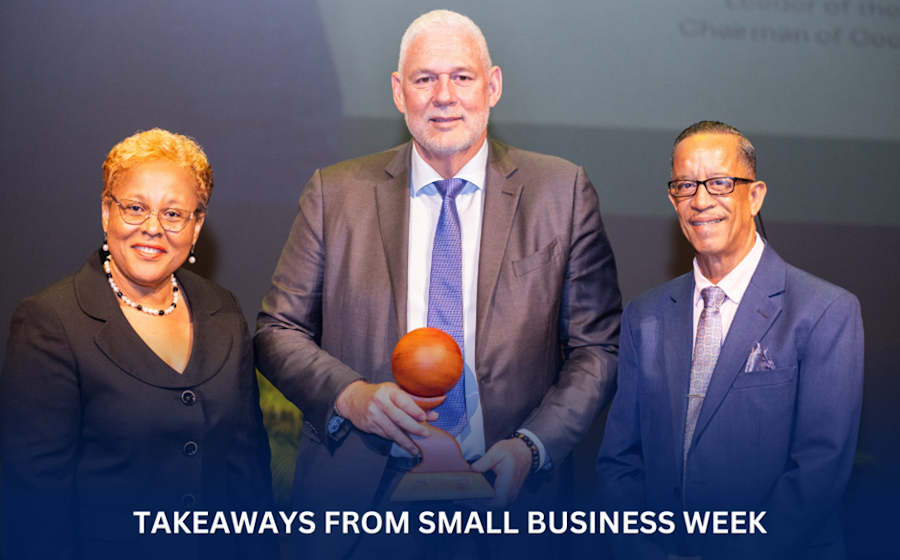
The dust has settled…..the daily briefings are over. No need to review any more storyboards or events scripts. Another Small Business Week has been excellently executed and stakeholders, in Barbados and regionally, have enjoyed a production filled with stimulating, challenging and thought-provoking conversations.
From the church service where, Roman Catholic Bishop Scantlebury set the stage with an inspiring sermon to the last event featuring Minister, Senator Lisa Cummins and every activity in between, the Week’s events lived up to their expectations.
Thanks to all those who made it possible - from the sponsors and contributors to the many speakers, industry partners and support teams - stakeholders from near and far coalesced to highlight and celebrate micro, small and medium enterprises and their contribution to national development.
Special mention must be made of the stimulating Leo Leacock lecture given by the Hon Allen Chastanet of St Lucia and the regional colloquium where the CDB’s Turner-Jones, and UWI principal Prof Robinson, painted a canvass of the state of the sector, not only in Barbados but also regionally.
Small Business Week 2024 celebrated its 21st edition of a week of activities and notably has come of age. With such events the next step is always to identify areas of further development and opportunities to advance actionable items. Key performance indicators provide a framework for measurement to ensure that progress is being moved in the pursuit of facilitating the growth of the MSME sector. Similar to previous years, two - three key deliverables will be identified to give stakeholders key activities for engagement and collaboration in the year ahead.
Three key themes stood out from this year’s events which will form part of the policy and programming agenda for the ensuing months. These areas are:
- Access to diverse finance solutions
- Digital revolution and adaptation
- Regulatory environment for business.
Whereas much research has been done on the impediments to growth and access to finance remains the leading issue, the conversation around this topic suggests some diversification of the issue. The current state of play for the MSME sector is not just access to seed capital and debt financing but a need for equity financing to be unlocked for the sector. An urgent call has been made for the Junior Market to become a reality sooner rather than later and for venture capital, factoring and other types of products to be added to the suite of financial offerings for the sector.
The digital revolution has been with us for some time. The COVID-19 pandemic was the catalyst for the adoption of technology across all areas of the population. Every aspect of life was converted to a digital operation, catapulting the adoption of technology as the new normal. Derivatives of this now include digital payments and mobile wallets, generative AI and robotic technology - all of which are at the doorsteps of business in the region. The sensitisation of MSMEs to these technologies and the capacity building to facilitate adoption is more acute than ever before. It is therefore incumbent that strategies be deployed to address this revolution for actors of business.
Ultimately, the regulatory regime will determine the speed at which a number of developments will occur in the business community. Enabling legislation and a facilitatory policy space are required to drive business. A present assessment shows the regulatory regime is not enabling. Legislation is archaic and not fit for purpose, compliance is costly and a deterrent to business, and policies are needed to ensure business can be done seamlessly across borders and across social platforms in the case of social media. To date local firms are excluded from trade on well-known platforms like Google, Facebook, etc., due to a lack of global e-commence agreements between Barbados and key jurisdictions.
There is therefore much work to be done in the ensuing year as we look forward to 2025. The takeaways will provide a blueprint for the work plan of the SBA and its partners and allow for the measurement of the KPIs established. We look forward to the report to be shared with stakeholders at the next week of activities.